Hardwood Floor Water Damage in The Bronx, NY
A radiator valve in your Grand Concourse Art Deco co-op is bled for the season and left weeping against the baseboard, and the inlaid oak border along that wall darkens and swells for days before you spot it. We answer live and get drying mats down fast.
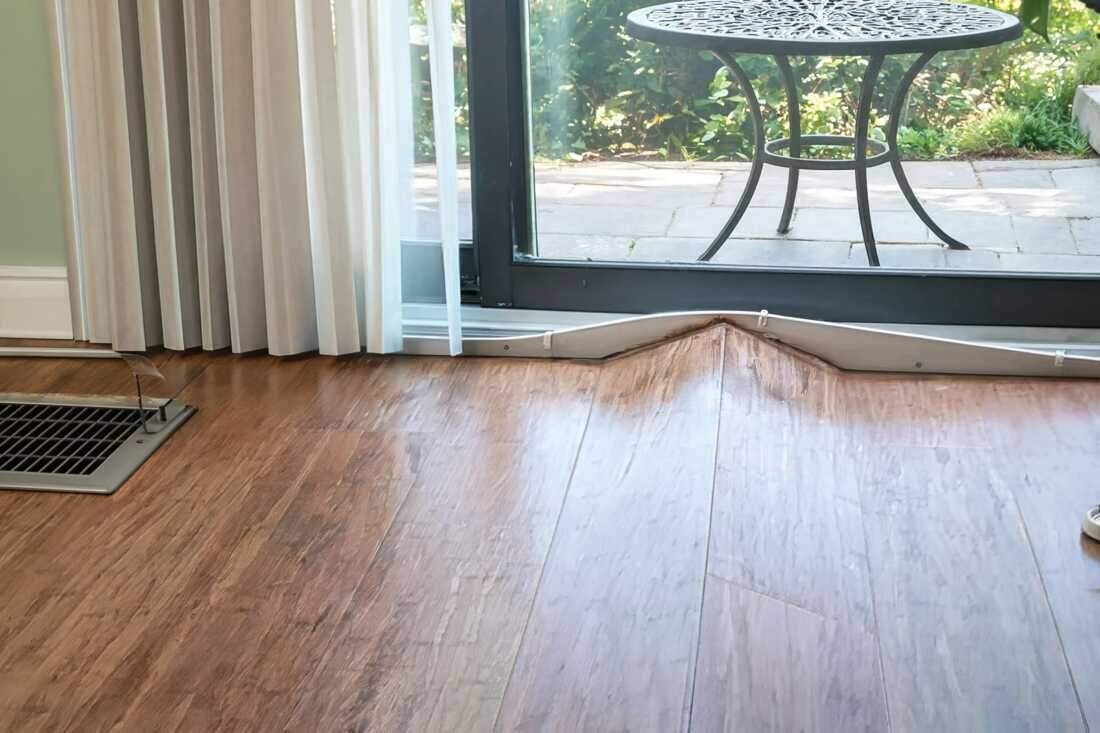
A lot of the water-damaged hardwood floors we dry in the Bronx come from the heat, not the plumbing. The prewar co-ops along the Grand Concourse and the walk-ups off Fordham Road still run on steam, and a radiator valve that seeps, a bled air vent left open, or a return line sweating in a closet drops water right at the baseboard where the finished oak meets the wall. Many of those Art Deco lobbies and apartments were laid with a bordered oak floor — a plain field ringed by an inlaid strip — and the border is exactly where the radiator sits, so the pattern piece takes the water first. Steam-system water is often warm and mineral-laden, which drives into the grain faster than a clean cold supply line would.
We answer the phone ourselves, day or night, with no service in between. A crew loads vacuum drying mats and moisture meters and heads up from our Brownsville base, usually about 45 to 60 minutes depending on the bridge corridors. On site we read the finished boards and the subfloor as separate layers, map how far the wet crept along the border and out into the field, and set mats to draw the moisture up through the planks rather than tearing an inlaid floor out. Hardwood floor water damage repair on a bordered floor is slow and deliberate, because the pattern only reads right if the whole thing dries and settles evenly. We photograph the source and log every reading; we document the loss in writing, and your carrier decides what it covers.
What we cover in The Bronx
- Vacuum mats over the wet run — sealed panels lift trapped water up through the boards and the inlaid border, so an Art Deco floor dries in place instead of coming up.
- Board and subfloor metering — a pin meter reads each plank and the framing under it, so warm steam water that soaked deep gets dried to the species' real target, not a surface guess.
- Cupping eased flat — steady, even drying settles swollen border and field boards back down before they crown, crack, or split at the seams.
- Pattern-matched replacement — border or field pieces past drying come up individually, matched to the original stock, and refinished into the surrounding floor so the inlay reads continuous.
Full detail on this service: Hardwood Floor Water Damage in Brooklyn · or see every water damage service we provide in The Bronx.
Common questions in The Bronx
The water was from a leaking radiator, not a burst pipe. Does steam water damage the wood differently?
It can be harder on the wood. Steam-system water often comes off warm and carries minerals and rust from old iron pipe, and warm water penetrates the grain faster than a cold clean supply line, so a slow radiator seep can soak deeper than its size suggests. It also tends to stain — the rust marks the wood where it sat. The drying is the same in method: mats over the run, metered daily to the wood's target. What changes is that we watch for staining that a refinish has to sand through, and we tell you up front if the mark is set deep enough to show after the floor is dry.
The leak sat at my foyer border for a week. Is mold already growing under the boards?
It's possible, which is why we meter the subfloor, not just the surface. Mold needs steady moisture and time, and roughly a couple of days of a wet, unventilated cavity is enough for it to take hold under a floor. When we open our readings we check the boards, the subfloor, and the base of the nearby wall; if the layer beneath is still wet, that is where growth starts, and drying it to target is what stops it. If we find mold already established, we tell you and address it as part of the work rather than sealing a fresh finish over a problem that keeps going.
How do you dry an inlaid border floor without wrecking the pattern, and how long does it take?
Carefully and slowly. A bordered Art Deco floor mixes strip and inlay running in different directions, and each has to give up moisture at the same steady pace or one part cups while the other stays flat. We seal mats over the whole wet zone rather than one strip, meter across the pattern, and hold the drying even. Plan on several days to about a week, longer if the water sat. The reward for the patience is a floor that settles level as one piece, so the inlay still lines up and a light refinish is all it needs.
One room of my Bronx apartment has laminate from a past renovation, and it got wet too. Can that be dried?
Usually not, and it's better to hear that early. Laminate floor water damage almost always ends in replacement: the plank is a printed layer over a fiberboard core, and once that core soaks it swells and stays swollen — the edges puff, the layers separate, and mats won't press them flat again. The save is the subfloor underneath. We pull the ruined laminate, dry the base to a metered target, and you lay new flooring over something that won't feed mold beneath it. The original oak in the rest of the apartment is the opposite case — dense old stock that nearly always dries and stays down.
Licensed, insured & trained to industry standards


Radiator soaked your Bronx floor? Call now, we answer live.
Reach a real person any hour at (347) 906-9419. A Brownsville crew loads vacuum mats and meters and heads your way to extract, dry the wood in place, and match any border or field boards the water took, with the loss documented in writing for your carrier.
Call (347) 906-9419