What Water Damage Restoration Costs in Brooklyn
Catch a supply line within the hour and you might pay a few hundred dollars to dry it out. Sleep through the same leak and you're looking at a four-figure job. Here's what Brooklyn homeowners actually pay, job by job, and what moves the number.
Short answer: the typical Brooklyn water damage restoration cost lands between $1,500 and $6,000, with most single-event losses settling around $3,000–$3,500. One damp room caught early is closer to $500. A cellar that flooded and sat overnight, or a sewage backup, runs past $7,000 and can clear $10,000 once mold and rebuild are added. Three things move the number more than anything else: how much water there is, how dirty it is, and how long it sat before a crew pulled it out.
Below is the price by job type, then a plain-English breakdown of what pushes a bill up or down, where mold work gets added, how a homeowner or HO-6 policy splits the cost with you, and how to read an estimate so you are not surprised on the invoice. Numbers here are 2026 planning ranges from real jobs across Brooklyn, not online averages pulled from another state.
Water damage restoration cost by job type
Restoration prices are driven by scope, not by a flat rate. A single soaked closet and a flooded finished cellar are different jobs with different crews, equipment counts, and days on site. Here is where the common Brooklyn jobs land.
| Job type | Typical Brooklyn range | What's usually included |
|---|---|---|
| Small single-room water removal & drying | $500 – $1,500 | Extraction, 2–4 days of drying equipment, moisture mapping |
| Average multi-room water damage job | $1,500 – $4,500 | Extraction, drying, some drywall and baseboard cut-out, antimicrobial treatment |
| Ceiling water damage repair | $500 – $2,500 | Drying the cavity, cutting the wet section, replacing and finishing drywall |
| Water-damaged floor repair | $1,200 – $4,000 | Floating or drying hardwood, replacing warped boards or soaked subfloor |
| Flooded basement / cellar cleanup & drying | $3,000 – $8,000 | Pump-out, extraction, structural drying, often partial demo of finished walls |
| Sewage / Category 3 cleanup | $4,000 – $10,000+ | Containment, PPE, contaminated-material removal, disposal, disinfection under IICRC S500 |
| Mold removal & remediation (add-on) | $1,500 – $6,000 | Containment, HEPA filtration, material removal, clearance check |
These are planning ranges. Your job will sit somewhere inside one once a technician meters it. Reliable Brooklyn Water Damage Restoration puts a firm scope and price in writing after the on-site look, before any equipment goes in, and the invoice matches that scope.
What drives water damage repair cost up or down
Two leaks in the same building can cost a homeowner ten times apart. The variables below are what separate a $600 dry-out from a $6,000 rebuild, roughly in the order they matter.
- Water category drives more of the bill than anything else. Clean water from a supply line is the cheapest to dry. Gray water from a dishwasher or washing machine sits in the middle. Black water from a sewage backup or a backed-up cellar drain is the priciest: it needs containment, protective gear, and disposal under IICRC S500, and most porous material it touched gets cut out rather than dried.
- How long it sat is the variable you can still affect. Water caught in the first hour or two often dries in place for a few hundred dollars. Water that soaked through a Friday night usually means cut-out drywall, lifted flooring, and mold work added to the bill. The cost roughly doubles at the point porous material can no longer be dried and has to be removed.
- Area and depth. We meter how far the water wicked, not just the puddle you can see. One bathroom is a small bill. A finished cellar under two inches of water, where the moisture climbed the wall studs, is a large one. Brooklyn's below-grade cellars are the classic example: water collects at the lowest point and sits against the foundation, so the wet zone is bigger than it looks from the stairs.
- What got wet. The finishes set the rebuild half of the number. Prewar plaster and lath in a Park Slope brownstone, original oak floors, decorative crown molding, all cost more to dry and restore than tile over a slab. Plaster in particular holds water longer than modern drywall and is slower to dry, so it adds equipment-days even before any repair.
- Access and the building type. A third-floor co-op with a tight stair and no elevator takes longer to set up and break down than a ground-floor unit, and that labor lands on the invoice. Shared walls and ceilings in a multi-unit building can pull a neighbor's space into the same loss.
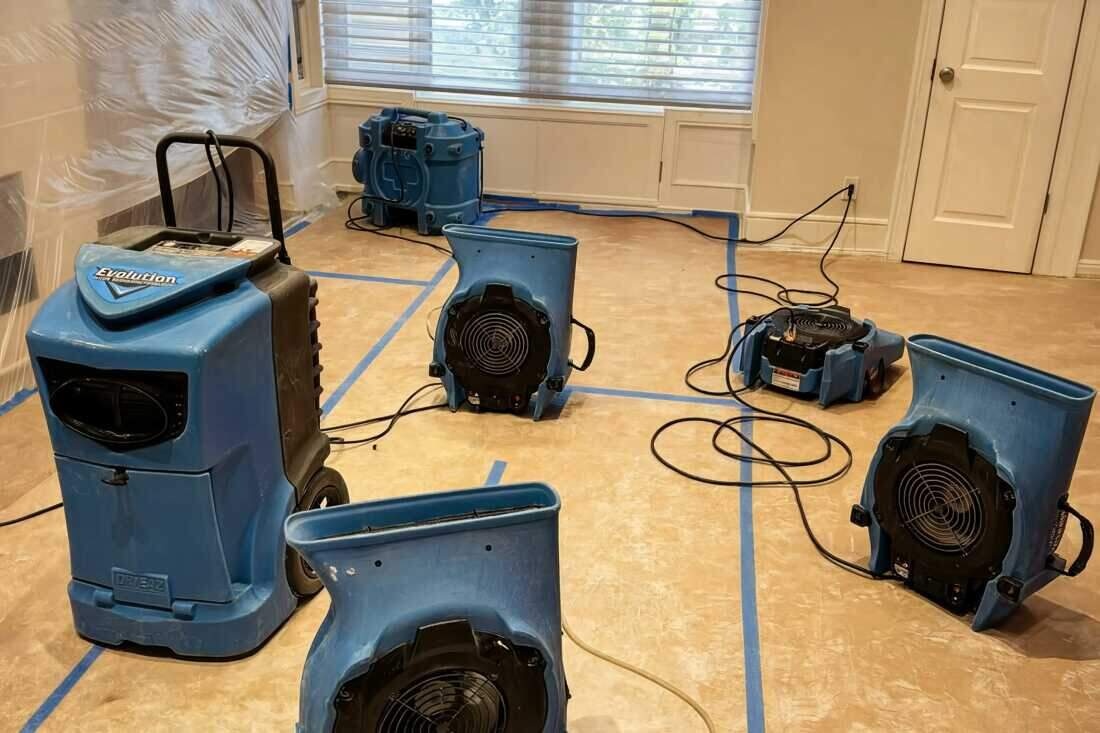
Mold remediation cost, and when it gets added to the bill
Mold work is priced separately from the dry-out, and it shows up whenever wet material sat long enough to grow. Drywall, plaster, or carpet left damp for more than a day or two starts colonizing, and at that point drying alone no longer fixes it. Brooklyn mold remediation cost runs about $1,500–$6,000, set by the square footage of growth and where it sits.
- Surface growth on visible drywall is the cheap end of mold removal cost, often $500–$1,500 for a small area. We clean or remove the affected face, treat it, and dry the cavity.
- Black mold inside a closed wall cavity is the expensive end, often $3,000–$6,000+. Black mold removal cost is higher because the work is contained: we tent the area, run HEPA air scrubbers, and cut the contaminated material out under negative air so spores don't spread to the rest of the home.
- A mold inspection, if you want growth confirmed and mapped before work starts, typically runs $300–$600 in Brooklyn. An independent air or surface test with lab results costs more. In New York, large remediation jobs may legally require an inspection by a separate licensed assessor from the company doing the removal.
The surest way to hold the mold number at zero is to dry the structure fast, before anything takes hold. Cellars and bathrooms are where Brooklyn mold starts most often, because they stay humid and the water has somewhere low to sit. Our mold removal page walks through the containment and clearance process in detail.
Does homeowner or co-op insurance cover it?
A sudden, accidental loss is usually covered by a homeowner's, renter's, or co-op HO-6 policy. A burst pipe, a washing-machine hose that lets go, a water heater that fails, an upstairs neighbor's overflow coming through your ceiling, those are the textbook covered events. The repair to your finishes is the covered part; the failed appliance or pipe itself usually is not.
Two things are commonly not covered, and they catch Brooklyn homeowners every year:
- Gradual leaks you knew about, or long-term seepage, are generally excluded as a maintenance issue rather than a sudden loss.
- Surface flooding, water rising in from outside, needs its own FEMA or private flood policy. A standard homeowner or HO-6 policy will not pay for it. Sewer or drain backup is often a separate add-on rider too, so check whether you carry it before you assume a cellar backup is covered.
If it's a co-op or condo, the line between what your HO-6 covers and what the building's master policy covers depends on your bylaws, and the two carriers sometimes negotiate over a shared-wall or ceiling loss. Either way you pay your deductible, commonly $500 to $2,500. Reliable Brooklyn Water Damage Restoration documents the loss room by room with photographs and moisture logs, then bills your carrier directly. We write the scope and supply the documentation; your adjuster decides what the policy pays. We never promise an outcome from another company's underwriter. Our water damage insurance claims page has the full walkthrough.
Deductibles, payment plans, and paying for it
Homeowners ask two money questions before they book: what do I actually pay out of pocket, and can it be split. On a covered loss the answer is usually just your deductible. Reliable Brooklyn Water Damage Restoration bills the carrier directly, so the insurer's share never passes through your hands, and the deductible itself commonly runs $500 to $2,500. On an uncovered loss (a long-neglected leak, groundwater with no flood policy) some water remediation companies offer payment plans and some don't, so settle that before any equipment goes in. Our rule is simpler: the scope and the price go in writing before work starts, and how the bill gets paid is part of that same conversation, not a surprise on the invoice.
How to get an accurate estimate
No honest number comes over the phone. The wicking you cannot see and the moisture trapped behind a plaster wall decide the price, and reading those takes a moisture meter, not a guess. Be wary of any company that quotes a flat figure sight-unseen before anyone has metered the damage; the real cost is in the readings.
A Reliable Brooklyn Water Damage Restoration technician comes out, maps the moisture, photographs the source, and hands you a written scope and price before a single air mover runs. The invoice then matches that estimate. A few things that keep the number accurate and lower:
- Call early. Every hour the water sits adds material to the scope. We're based in Brownsville and usually reach most of Brooklyn in around 45 minutes, depending on traffic, with a real person answering the line 24/7.
- Photograph everything before it's moved, and find your policy and deductible. It speeds the claim and the documentation we hand your adjuster.
- Ask for the scope in writing before equipment goes in, including the equipment-day count and what counts as "dry." That's the line that determines when the meters come off and the billing stops.
Call (347) 906-9419 any hour to get a technician out and a written price in hand.
Get a firm price, in writing
A Reliable Brooklyn Water Damage Restoration technician reads the damage on site, meters the moisture, and hands you a written scope and price before any equipment runs. We answer live 24/7, with no obligation to book.
Call (347) 906-9419