Ceiling Water Damage Repair in Brooklyn, NY
That brown ring is the small visible end of a wet patch already gallons wide behind the drywall. We trace the leak above, dry the joist bay to a meter reading, and rebuild the panel so the stain never bleeds back. Call any hour: a crew rolls.
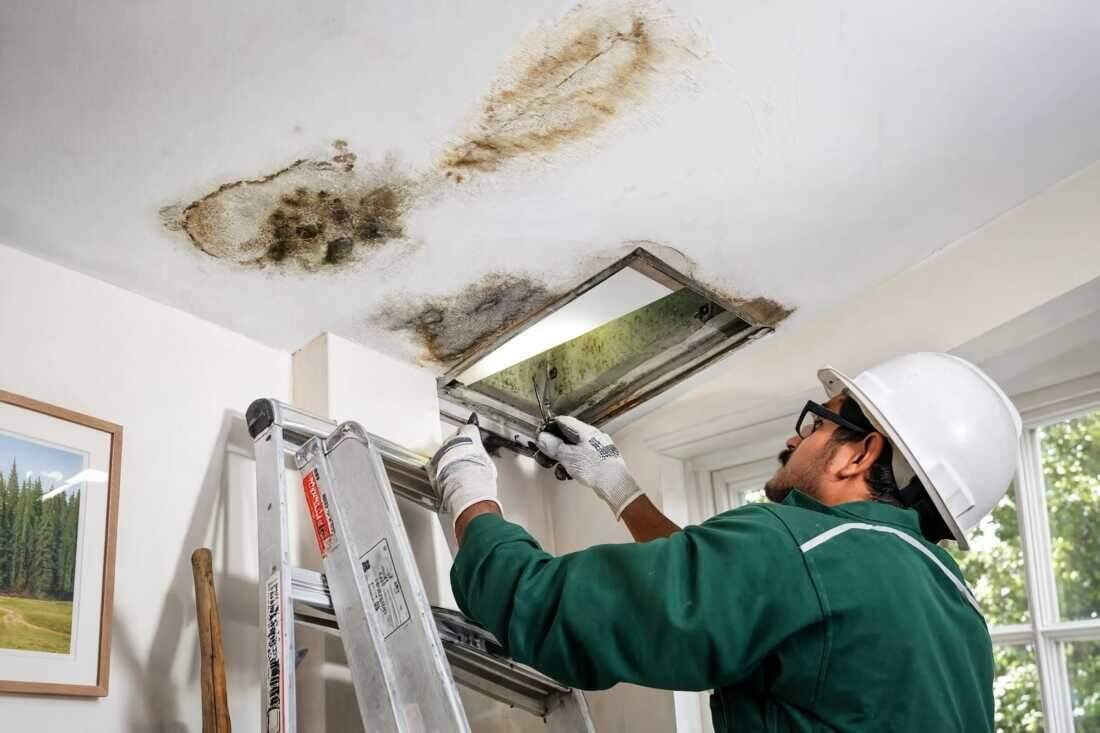
By the time water shows on a ceiling, it has been hiding above it for a while. The stain is the last symptom, not the first: the water has already run the joists, soaked the insulation, and pooled on the back of the drywall, and a saturated sheet of gypsum holds forty or fifty pounds before it bows and lets go. We don't paint over that. We trace the source overhead, dry the cavity to a number on a meter, and rebuild the surface so it reads flat and the old ring won't ghost through fresh paint. It's two jobs, really: kill the leak up top, then fix and finish the ceiling below it.
What's included in the repair
- Tracing the leak above — we follow the water to where it gets in: a tub or toilet in the unit upstairs, a roof or flashing leak over a top-floor walk-up, a sweating HVAC condensate line, or a supply pipe buried in the joist bay.
- Controlled drain & make-safe — a bulging, water-filled ceiling gets relieved on a tarp on our terms, floor covered and furniture moved, instead of dropping forty pounds of wet plaster on yours.
- Drying the joist cavity — we meter the framing behind the surface, then aim air movers and a dehumidifier into the open bay until the insulation and joists read dry all the way through, not just to the touch.
- Drywall & finish rebuild — we cut out the ruined gypsum, hang new board, then tape, skim, and prime with a stain-blocker so the ceiling takes paint without a seam or a shadow of the old stain.
How the job runs, step by step
- A real person answers and dispatches
You reach a technician 24/7, never an answering service. We take your address and the floor you're on and send the nearest crew. From our Brownsville base we usually reach most of Brooklyn in around 45 minutes, depending on traffic.
- Find the source, make the room safe
The crew traces where the water comes in, kills power to any wet fixture or fan overhead, and relieves a sagging panel on a tarp before it can let go on the room.
- Open the cavity, meter it, dry it
We cut out the wet area, take readings off the joists and insulation, and leave the gear running until the bay reads dry on the meter. Dry to the hand is not dry behind the wall.
- Rebuild and finish
New board goes up, then tape, a skim coat, and a stain-blocking primer, so the ceiling is ready to paint and the old ring won't bleed back through the next coat.
When to pick up the phone about a ceiling
Some signs are obvious; some are a hairline warning you can still get ahead of. Call if you see any of these:
- A brown or yellow ring that keeps creeping wider, or a damp patch that comes back through fresh paint within weeks.
- A ceiling that sags, bubbles, or feels spongy when you press it — that's water pooling behind the drywall, and the panel is close to failing.
- Active dripping, peeling paint, or cracked joint tape — and a musty smell that shows up days later, which usually means the cavity never dried out.
A leaking Brooklyn ceiling usually starts with a pipe (see burst & frozen pipe repair) or a worn roof, which we handle under roof water damage. Once the cavity is open we run structural drying, and if the area sat wet for days we check for mold before we close it back up.
Common questions
How fast can you get to my ceiling leak?
Fast, any hour. Crews run from our Brownsville base and cover all of Brooklyn plus the other four boroughs, and we usually reach most of Brooklyn in around 45 minutes depending on traffic. The wet patch overhead spreads while you wait, so we don't hold the call for a callback. A person picks up and a crew is already on the way.
My ceiling is bulging and full of water — should I poke it to drain it?
No. Leave it alone and call us. That brown ring is only the visible edge of a much wider wet patch, and waterlogged drywall is carrying real weight directly over your head. Jab it with a screwdriver to "let it drain" and a panel that was holding can come down all at once, plaster and water together. We relieve it on a tarp on our terms, with the floor covered, then dry the bay behind it.
Can you find the leak above, or do you just patch the stain?
Finding the source is the first thing we do; patching the stain is the last. In Brooklyn it's usually a tub or toilet in the unit upstairs, a roof or flashing leak over a top-floor apartment, or a supply line tracking through the joist bay. Skim over a stain while water is still getting in and it bleeds right back in a few weeks, so we fix the leak at the source before a single new sheet of board goes up.
Will my insurance cover the ceiling repair?
Often, yes. Sudden, accidental water (a burst supply line or an overflow from the unit above) is usually covered under a homeowner's, co-op, or renter's policy. We photograph the source, log the moisture readings, and bill your insurer directly. We document the loss in full; your carrier decides what's covered, and a detailed, metered scope gives the claim its best footing. See our insurance claims guide.
Why a Brooklyn ceiling leak is rarely where it shows
In Brooklyn's older brownstones and walk-ups, a ceiling stain is usually a message from the floor above: a tub overflow in the unit upstairs, a failed supply line inside a partition wall, or a tired roof over a top-floor apartment. Water almost never drips straight down. It tracks along the joists and surfaces a room or two from where it started, which is why guessing at the wet spot rarely fixes the problem and why a stain that comes back through fresh paint is so common. Reliable Brooklyn Water Damage Restoration opens the cavity, meters the framing, and dries it to a documented reading before any new board goes up. A stain-blocker over a wet cavity buys you a few weeks; a dry-out you can prove on a meter is what actually holds.
The repair to a water-damaged ceiling is really two trades stacked on each other, and most callbacks come from skipping the first. Stop at the quick fix you can see (cut out the stained gypsum, hang new board, repaint) and the framing and insulation behind it stay soaked, so the ring ghosts back through the primer and, a few weeks on, a musty smell tells you mold took hold in the bay. We treat the cavity as the real job: meter the joists, dry them to target with air movers and a dehumidifier, and only then rebuild the surface. In prewar Brooklyn that drying step matters more, because old plaster-and-lath holds water far longer than modern drywall and reads damp long after the surface looks fine. Get the cavity dry first and the finish work lasts; rush the finish and you pay for the ceiling twice.
Reliable Brooklyn Water Damage Restoration handles stained, sagging, and dripping ceilings in Brownsville, East New York, Bed-Stuy, Crown Heights, Flatbush, Bushwick, Williamsburg, Park Slope, Bay Ridge, Canarsie, Coney Island, Mill Basin, and the rest of Brooklyn, plus Queens, Manhattan, the Bronx, and Staten Island. Call (347) 906-9419 any hour and a technician picks up.
Where we work across Brooklyn & NYC
We repair leaking ceilings across: Brownsville · East New York · Bedford Stuyvesant · Crown Heights · Flatbush · Bushwick · Williamsburg · Park Slope · Bay Ridge · Canarsie · Coney Island · Mill Basin · Queens · Manhattan · The Bronx · Staten Island.
Licensed, insured & trained to industry standards


Stop the leak, save the ceiling — call now
A Brooklyn crew is on call 24/7. The sooner we trace the source and dry the cavity, the less ceiling we cut out and the smaller your repair.
Call (347) 906-9419