Hardwood Floor Water Damage in Bushwick, NY
Your Bushwick loft was a warehouse once, and the washer plumbed into it seeps behind the cabinets for days. By the time the engineered plank feels spongy, the water has spread flat across the slab underneath. Caught while it's still on top, most boards dry in place.
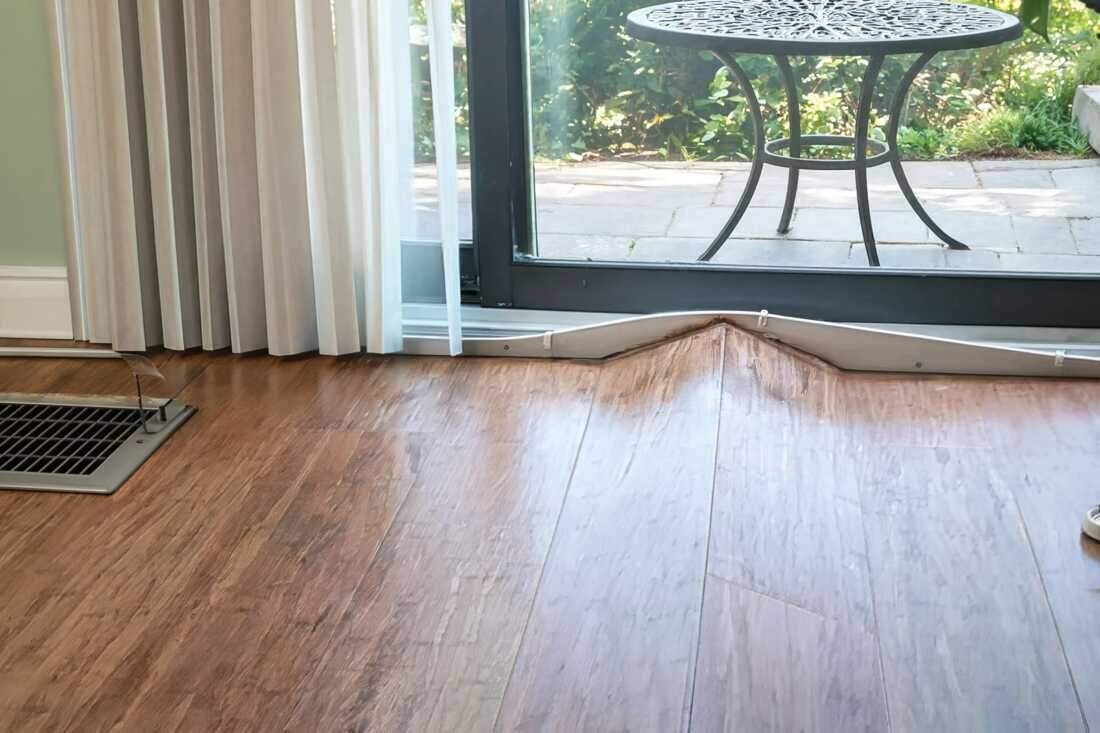
Hardwood floor water damage in Bushwick behaves differently than it does in a plaster walk-up, and the slab is why. The industrial-to-residential conversions along Morgan and Flushing Avenues laid engineered plank or a thin wood overlay flat over poured concrete, and when an appliance line lets go the water doesn't pool where it started: it sheets sideways across the slab and wicks up into the wood a room away. So the wet-looking patch by the dishwasher is the smallest part of the problem, and the boards over the far corner of the slab are often the ones drinking hardest.
We repair water-damaged hardwood floors the same way regardless of which leak sent the water. First we pull what's standing, then a pin meter reads the plank, the glue line, and the slab as three separate numbers, because concrete holds moisture at that interface and feeds it back into the wood long after the surface feels dry. Vacuum mats go over the run the readings actually flag. Engineered plank tolerates far less soak time than solid oak before the veneer lifts, so the early call is what keeps a Bushwick floor a drying job instead of a tear-out. From our Brownsville base a crew usually reaches Bushwick in about 45 minutes, and a live person picks up any hour.
What we cover in Bushwick
- Vacuum drying mats — sealed panels put the wet run under suction and draw water up out of the plank, so the floor dries where it lies instead of coming up off the slab.
- Metered at three layers — a pin meter reads the veneer, the adhesive line, and the concrete slab separately, because a loft floor can read dry on top while the slab underneath is still feeding it.
- Cupping caught early — controlled drying settles the swollen boards back flat before the edges crown or the joints split, on a floor that has little tolerance for a rushed dry-out.
- Board replacement when the veneer's gone — planks whose wear layer has already delaminated get lifted, replaced, and refinished into the field so the repair reads flush with the rest.
Full detail on this service: Hardwood Floor Water Damage in Brooklyn · or see every water damage service we provide in Bushwick.
Common questions in Bushwick
My Bushwick loft has engineered plank glued over a concrete slab. Does it dry like the solid oak in an old walk-up?
No, and the difference decides the whole job here. Solid oak is thick and gives up water slowly through its own grain; engineered plank is a thin hardwood veneer bonded to a plywood or fiberboard core, and once that glue line soaks it lets go and the surface delaminates fast. It tolerates far less drying time before the damage is permanent. The slab under it is the other half: concrete doesn't absorb much, but it traps moisture right at the seam with the plank and feeds it back up for days. We meter the veneer, the adhesive line, and the slab as three readings. Mats usually pull moisture from the plank side, but where the veneer has already lifted, those sections need replacing.
The leak came across my floor from the unit next door, not down through the ceiling. How did it reach me sideways?
The slab again. Your loft floor sits flat over poured concrete, and concrete is a highway for water. When a line lets go in the next unit, it spreads out across the slab and follows it under the wall into your space long before it would soak down to a ceiling below. That also means the wet footprint is wider than the damp spot you can see, and often driest right where you found it. We meter across the slab and the plank to map how far it actually traveled, then set mats over the real wet edge rather than the visible stain. Guessing from the surface is how a Bushwick loft gets a floor that reads dry and grows mold under it a month later.
A washer line let go in my Bushwick apartment. What should I do before your crew gets there?
Shut the supply valve if you can reach it, and lift rugs and furniture legs up off the wet wood so nothing traps moisture under it. Stay off the floor as much as you can — every footstep drives water deeper into the joints. Don't aim a box fan straight down at the boards; that skins the surface dry while sealing moisture into the core and, on engineered plank, into the glue line, which is exactly the layer you're trying to save. Snap a few photos of the standing water before it spreads. Then call (347) 906-9419 so we extract while the water is still on top of the floor.
How long can the boards sit wet before a Bushwick hardwood floor stops being salvageable?
Roughly 24 to 48 hours of contact is the honest window, and less for engineered plank than for solid oak. After that the wood swells and cups, tongue-and-groove joints crack, and a wet subfloor or veneer core starts to delaminate, which pushes the job from drying into replacement. The trouble in these conversions is that the water rides the slab out of sight, so the surface can look fine while the wood over the far side of the room is saturated. Call before it looks obvious — we set mats and recheck the readings daily until the plank and the slab both hold dry.
The leak came down from the unit above in my Bushwick walk-up. Whose insurance pays for my floor?
It depends on what failed and where the pipe runs. If the upstairs neighbor's own supply or waste line let go, their policy or the building's is usually in the conversation; if it's a shared galvanized riser inside the wall, the source location tends to decide who's responsible. We don't promise any carrier's answer. What we control is the record — a moisture map of how far the water ran, the source point, dated photos, and daily readings — so your adjuster places responsibility on facts instead of a guess. We document the loss; your carrier decides what's covered. Where the policy allows, we bill the insurer directly.
Licensed, insured & trained to industry standards


Engineered plank going soft in your Bushwick loft? Call now.
A live person answers any hour, no answering service, and a Brooklyn crew rolls from our Brownsville base with mats and meters loaded. We extract, read the plank and the slab as separate layers, dry the boards in place where they can be saved, and document the loss for your carrier. The veneer over a soaked slab doesn't wait, so the sooner we're metering it, the more of your floor comes through. Call (347) 906-9419.
Call (347) 906-9419