Hardwood Floor Water Damage in Crown Heights, NY
A toilet tank cracks and runs all night in the top unit of a Franklin Avenue limestone row house, and by morning the oak with the inlaid feature strip in the apartment below is dark and cupping. We answer live and get drying mats down fast.
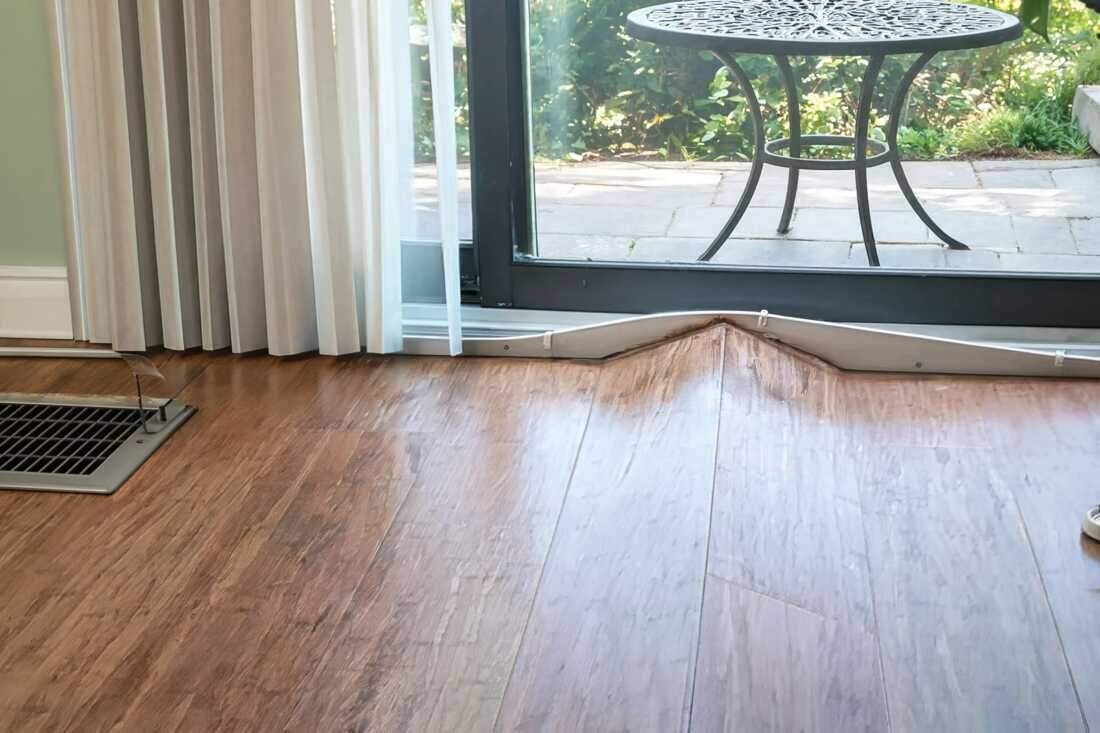
The limestone and brownstone row houses off Franklin and Nostrand Avenues carry some of the nicest original floors in Crown Heights — plain-sawn oak fields ringed or split by an inlaid feature strip, laid when the houses went up a century ago. When a fixture overflows a floor or two above, a toilet tank that cracks, a bathroom sink left running, the water works down through the ceiling and settles into that oak through the seams, and the decorative strip usually sits right where the water pools. The finish holds for a day while the wood below drinks, then the boards darken and the edges rise, and a floor you can't easily replace is suddenly the one at risk.
We don't wait on the building to find the shutoff. We extract the surface water, read each board and the subfloor against a dry reference, and set mat systems that pull the moisture up through the planks while the managing agent still sorts out the source upstairs. Hardwood floor water damage repair on an inlaid oak floor is slow and even by necessity — the field and the feature strip run different directions and have to dry at the same steady pace, or one cups while the other lies flat. We write down the whole water path, the ceiling entry, how far the wet spread, the subfloor readings, with time-stamped photos, so your renter's or HO-6 carrier and the building's policy both have proof. From our Brownsville base we reach Crown Heights in roughly 45 minutes, and a real person answers at any hour.
What we cover in Crown Heights
- Vacuum mats over the wet zone — sealed panels pull trapped water up through the oak field and the inlaid strip, so a decorative floor dries in place instead of being torn out.
- Board and subfloor metering — a pin meter reads each plank and the layer under it, so the floor is called dry off a number across the whole run, not the one board you can see.
- Cupping caught before it locks — steady, even drying settles swollen field and strip boards back flat before they crown, crack, or split at the seams.
- Feature-strip replacement matched — field or inlay boards past drying come up individually, matched to the original stock, and refinished into the floor so the pattern reads continuous.
Full detail on this service: Hardwood Floor Water Damage in Brooklyn · or see every water damage service we provide in Crown Heights.
Common questions in Crown Heights
The water came from a toilet a couple floors up. Is that contaminated, and does it change what has to come out of my floor?
It depends on what was in it. A cracked toilet tank is holding clean supply water, so that's a Category 1 loss and the oak can usually be dried in place. Overflow from the toilet bowl with waste in it is contaminated, and where that soaked into porous wood the boards come out rather than getting dried back into your home. There's also the trip down: water that ran through an old plaster ceiling before it reached you can pick up debris on the way. We test and log the water class as soon as we arrive and tell you plainly which boards are a drying job and which, if any, have to be replaced.
The boards are dark and there's a musty smell underneath already. Is the floor gone?
Not necessarily. Dark boards are often just the wood wet through, and staining that a refinish can sand out once it's dry; a musty smell means moisture is sitting in the subfloor or the cavity, not that the floor is beyond saving. What we do is meter the boards, the subfloor, and the base of the nearby wall to find where the wet actually is, then dry that hidden layer to target — which is also what clears the smell. If we find the boards have buckled loose or mold is already established under them, we show you the readings and tell you which sections have to be replaced, rather than guessing from the surface.
How do you actually know the floor is dry and safe to refinish, instead of just looking dry on top?
By the meter, not the eye. A hardwood floor's surface dries days ahead of the wood inside it and the subfloor below, so a floor can feel fine to your hand while the layer underneath is still soaked — refinish over that and you trap moisture that cups the boards again or feeds mold. We set a dry reference from unaffected wood of the same species, then read the affected boards and the subfloor daily until both hold at that target across the whole area. Only then do we call it dry and clear it for sanding. You get the readings, so the decision rests on numbers you can see.
If part of the inlaid oak has to be replaced, will the repair show in the pattern?
We work to keep it from showing, and drying in place is the first move because the best match for a century-old board is the one already there. Where field or feature-strip pieces are truly lost, we source oak of the same species and cut it to the pattern's dimensions, weave the new boards into the run instead of dropping in an obvious patch, and refinish across the whole area so the stain and sheen carry through. On a decorative floor a seam can still catch the light at a certain angle; if one is going to, we tell you before we start, not after.
Licensed, insured & trained to industry standards


Crown Heights oak going dark and cupping? Call now.
Reach a real Brooklyn crew any hour, 24/7. Call (347) 906-9419. We extract, meter each board and the subfloor, dry the oak in place from the subfloor up, and document the source and the whole water path for your claim.
Call (347) 906-9419