Hardwood Floor Water Damage in Park Slope, NY
A cast-iron fitting in the parlor-floor ceiling lets go overnight, and by the time you wake the original narrow-strip oak below is darkening and lifting at the seams. That wood can't be ordered to match, so the job is drying it flat before it cups for good.
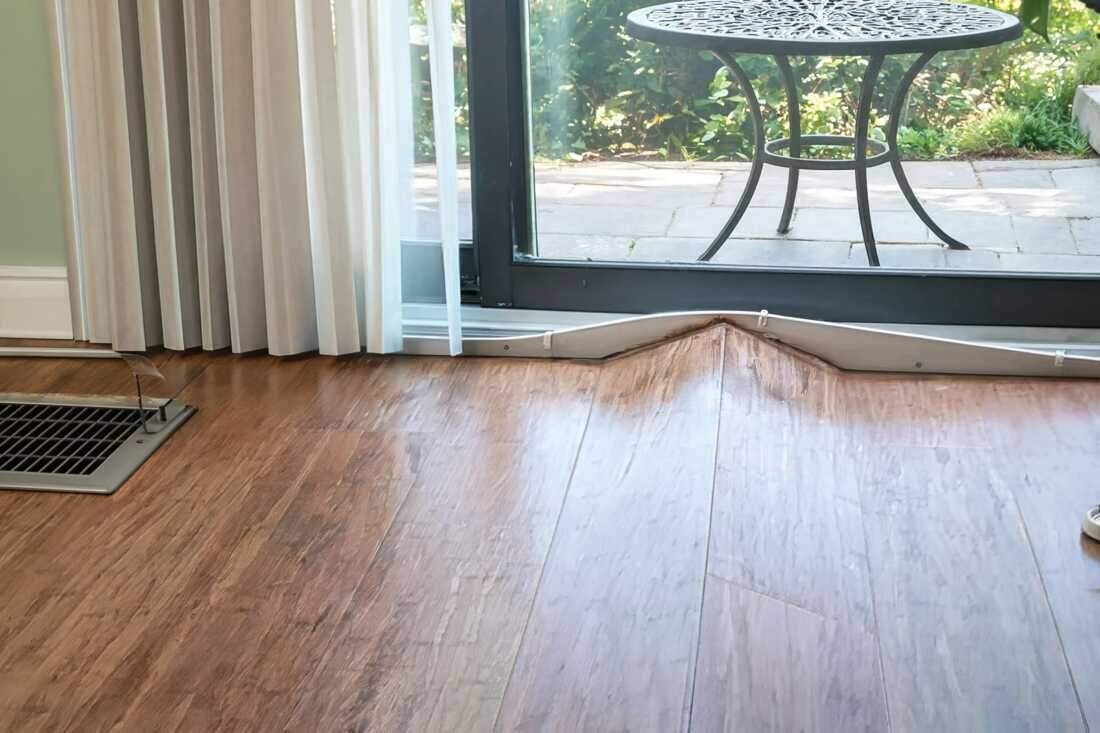
Park Slope brownstones hold some of the most intact original flooring in Brooklyn, and that's what makes a leak here a preservation job. The rows from Prospect Park West down to Fourth Avenue were laid with narrow-strip oak, fir, and pine that sit under decades of finish and cannot be matched at a lumber yard. When an old cast-iron plumbing fitting fails in a ceiling, or a finished garden level takes on water, that wood soaks fast. Old plank floors have gaps between the boards, so the water spreads sideways well past the visible stain and works down into the subfloor and the joist bays underneath.
We repair water-damaged hardwood floors in place, because on an irreplaceable floor the boards you keep are always the best match. A pin meter reads each board, the subfloor, and the joists against a dry reference for the species, and vacuum drying mats pull moisture up through the planks instead of prying the floor out. Hardwood floor water damage repair on original wood is slow and even by necessity — dry it too hard and cupping tips into crowning, which splits the boards for good. We log readings daily until the wood reads dry, and we photograph every board and write up the scope, so your insurer has a clear record of the loss. We document what happened; your carrier decides what's covered. From our Brownsville base we're usually in Park Slope inside about 45 minutes, and a live person answers around the clock.
What we cover in Park Slope
- Vacuum mat drying — sealed panels pull trapped water up through the original boards so we save an irreplaceable floor instead of pulling it up.
- Board, subfloor, and joist metering — a pin meter reads each layer against a dry reference, because a ceiling leak wets the joist bays you can't see, not just the boards you can.
- Slow cupping relief — controlled airflow settles swollen narrow-strip boards back flat; push it and cupping flips to crowning, which cracks and splits the wood.
- Photographed claim scope — board-by-board photos and the drying log document the original material, which matters when matching century-old milled stock has to be justified.
Full detail on this service: Hardwood Floor Water Damage in Brooklyn · or see every water damage service we provide in Park Slope.
Common questions in Park Slope
The original narrow-strip oak in my Park Slope parlor cupped after a ceiling leak. Can it be saved, or am I replacing the floor?
Cupped narrow-strip oak is usually the saveable case. Cupping means the board swelled, wetter underneath than on top, but the fibers haven't broken. If we get mats down while it's still in that cupped stage, the boards typically flatten as the moisture equalizes and drops to the species target, and the floor then wants a light sand and refinish for the surface while the original wood stays in place. The one thing we guard against is over-drying, which turns cupping into crowning — the centers hump up and the edges split — and that damage doesn't come back. So we dry slowly and read the meter every day rather than racing the wood.
The leak came down from the floor above through the ceiling. Should I worry about mold under my brownstone's hardwood?
Yes, and that's exactly why we meter below the surface, not just the boards. A ceiling leak that reaches the floor almost always wets the subfloor and the joist bays under it, and those closed cavities dry far slower than the planks you can see. Once wood sits damp past two or three days, mold starts on the underside where you'd never spot it until the musty smell shows up. We dry the cavity and read the joists as their own layer, so you're not refinishing a beautiful floor that's quietly growing mold underneath it. If we find growth already established from an older leak, we tell you and handle it rather than sealing a fresh finish over the top.
My parlor floor is fir and pine, not oak. Does softer old wood dry differently?
It does, and it needs a gentler hand. The old-growth fir and pine in these brownstones is softer and more open-grained than oak, so it takes water on faster and dents and checks more easily as it dries — a drying pace that's fine for a dense oak floor can split a pine one. We set a lower, slower target for that wood and read it daily, and we're careful about foot traffic and equipment weight on softened boards until they firm back up. The upside is that the same softness lets it release moisture and settle flat readily once the drying is steady. We meter it to its own species number, not the oak's.
My brownstone is in a landmark district. Does that change how the insurance claim works?
The landmark status doesn't change the drying, but it raises the stakes on documentation, since matching century-old milled boards is slow and costly and your insurer will want proof of the original material before it pays to replicate it. We photograph every affected board, record daily moisture readings, and hand you a written scope your carrier can work from, with the species and profile of the original flooring noted. We document the loss in detail; what's ultimately covered is your carrier's decision, not ours. A file that shows the wood was original and the drying was done right is what a floor claim on a landmarked house stands on.
Licensed, insured & trained to industry standards


Water on your Park Slope hardwood? Call before it cups.
Reach a live Brooklyn crew any hour at (347) 906-9419, no answering service. We extract, meter the boards and the joist bays under them, set vacuum drying mats, and document the loss for your insurer. Original strip oak and pine can't be reordered, so the floor that starts drying today is the one you keep — the longer the water sits, the more of it cups past saving.
Call (347) 906-9419