Hardwood Floor Water Damage in Queens, NY
The ice-maker line behind the fridge in your Forest Hills Tudor weeps for a week before anyone notices, and the oak out into the dining room is already ridging up at the seams. We answer live, and a floor caught this early usually dries flat where it lies.
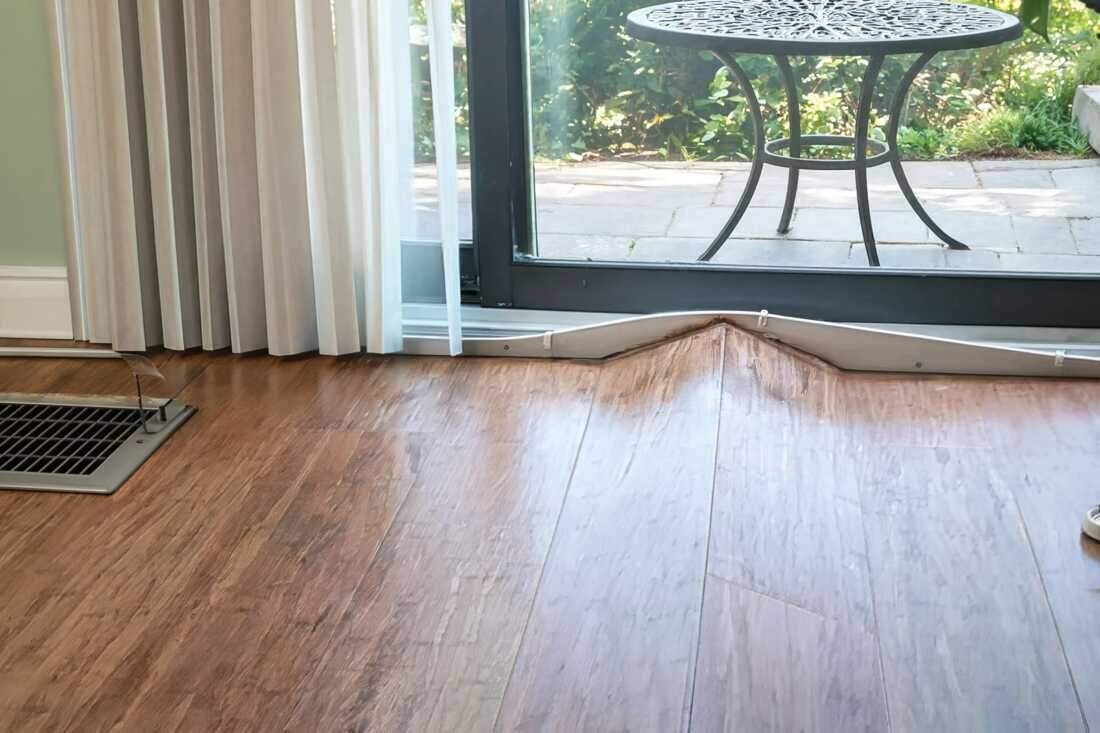
Hardwood floor water damage in Queens tends to be the quiet kind. Not a burst pipe you hear at 2 a.m. — a fridge ice-maker line, a dishwasher supply, a radiator valve that seeps a little at a time and soaks the subfloor under the kitchen and dining oak long before a single board looks wrong. The prewar co-ops of Forest Hills Gardens and the brick Tudors around Kew Gardens were laid with real strip oak, and a lot of the newer two-family builds carry engineered plank over concrete or plywood. Both cup the same way once water gets underneath: the board edges rise while the centers still lie flat, and by the time you feel the ridge underfoot the wood has been drinking for days.
Most water-damaged hardwood floors we take on in Queens never get torn out — they dry in place. A crew rolls from our Brownsville base, meters the finished boards and the subfloor as two separate layers, because one can read dry while the other stays soaked, and sets vacuum mats over the wet run to pull the moisture straight up through the grain. Hardwood floor water damage repair is slow work by nature, several days to a week under the mats, and there is no honest way to speed it without cracking the wood. What the early call buys is the ending: a floor metered and dried on time usually finishes at the sander, not the lumber yard. We reach most of the borough in roughly 45 to 60 minutes, traffic and the bridges depending, and a real person picks up at any hour.
What we cover in Queens
- Vacuum drying mats — sealed panels put the wet run under suction and draw the water up out of the boards before it settles deeper into the subfloor beneath them.
- Metered as two layers — a pin meter reads the finished oak and the subfloor to separate dry targets, so an engineered plank floor and the plywood under it each finish on their own number, not a shared guess.
- Cupping coaxed back flat — slow, even drying settles the swollen edges down; sand a floor before the meter says it is done and the humped centers lock in for good.
- Board replacement, then refinish — planks past drying come up one at a time, get matched to the surrounding oak, and the patch is sanded and finished into the field so it does not read as a repair.
Full detail on this service: Hardwood Floor Water Damage in Brooklyn · or see every water damage service we provide in Queens.
Common questions in Queens
The ice-maker line leaked for a week before I caught it. How do you tell how far the water actually went?
A slow seep spreads wider than a fast spill, because it has the time to travel. We put a pin meter on the boards near the fridge and work outward until the readings drop back to a normal dry number for your wood, and we read the subfloor separately, since water riding the plywood can surface a full room away from where it started. That map is what tells us the real wet edge, not the stain you can see. In a Forest Hills kitchen that opens to the dining room, the far corner of the dining oak is often wetter than the spot under the appliance, and metering is the only way to know before we set the mats.
How long does a water-damaged wood floor take to dry, and can I stay in the house while it runs?
Figure several days to about a week of mat drying, depending on how deep the water went, the species, and the size of the wet area — hardwood gives up water far slower than drywall or carpet, and rushing it is what cracks the boards. You can absolutely stay put. The mats and a low-grain dehumidifier work over the affected run, not the whole apartment, and the equipment hums rather than roars. We recheck the readings daily and pull each piece of gear only when that section reads dry to target, never when the surface just feels dry to your hand.
My Queens two-family has engineered plank downstairs, not solid oak. Does that dry the same way?
Sometimes, and metering is how we call it. Engineered flooring is a real hardwood wear layer bonded to a plywood core, so if the water was clean and we get to it early, it often dries in place like solid wood. What it does not tolerate is a long soak: once the glue lines between the plies let go, the plank delaminates and the surface peels, and no drying puts that back. We read each board and the core before committing to a path, and tell you plainly which planks are drying flat and which have separated. Solid oak we can nearly always save if the grain hasn't split; engineered is the coin-flip we settle with the meter.
Should I rent a floor sander and refinish it myself once it's dry, to save money?
Wait on that until the wood is verified dry, and honestly, on a cupped floor it's the wrong order. Sanding a floor that is still giving up moisture flattens the raised edges now, but as the boards finish drying and shrink back, the centers drop and you're left with a dished, uneven surface no finish hides. The move is to dry to the metered target first so the boards settle level on their own, then sand. If the cupping is mild and the wood reads dry, a careful DIY refinish is doable; if boards need lifting and matching, that's where a botched job costs more than it saved.
Licensed, insured & trained to industry standards


Oak cupping in your Queens home? Call now.
Call (347) 906-9419 and a person answers at any hour — no answering service. Wet oak does not wait: the longer the water sits in it, the deeper it settles and the fewer boards come through flat. A Brooklyn crew extracts, meters both layers, and dries water-damaged wood floors in place across Queens, then sands, refinishes, or replaces what the water took, with every step logged for your claim.
Call (347) 906-9419