Roof Water Damage in Flatbush, NY
A slate slips off the steep gable of your Ditmas Park Victorian, rain runs the exposed felt into a dormer valley, and it soaks the attic knee-wall for a week before a ring finally shows on the bedroom ceiling below.
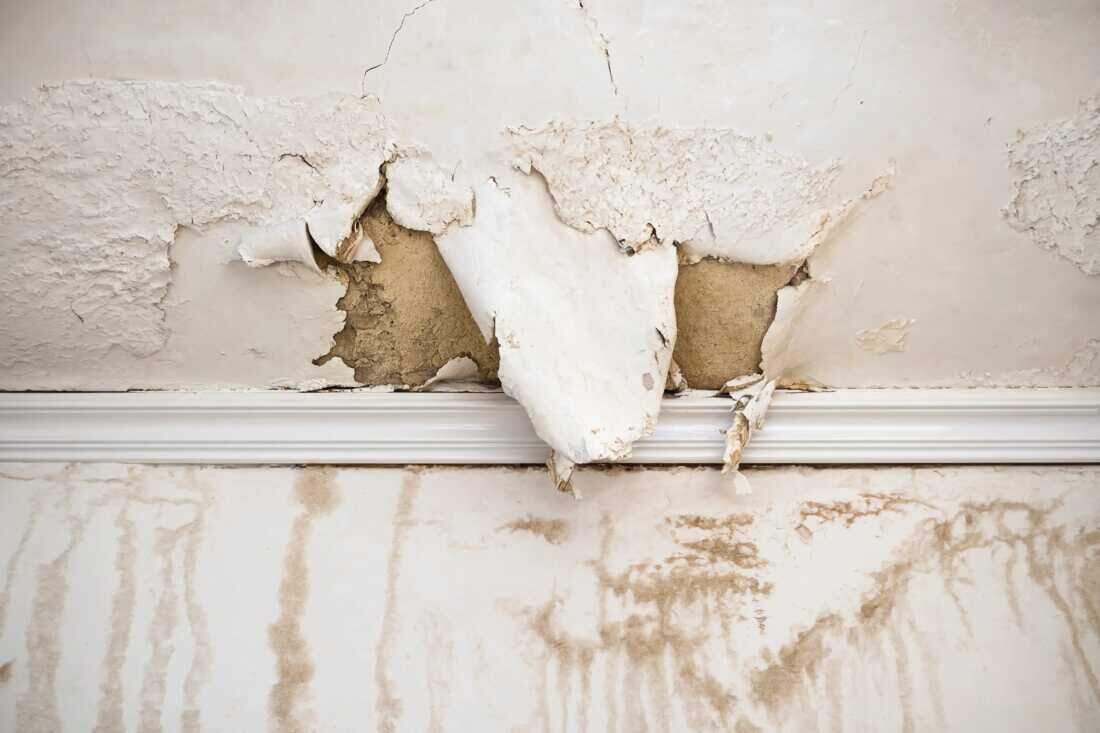
Flatbush is one of the few Brooklyn neighborhoods where a roof leak often starts on a steep pitched roof rather than a flat one. The Victorian houses of Ditmas Park and Prospect Park South wear slate and wood-shingle gables with deep valleys and dormers, and when a slate slips or a valley flashing corrodes, water gets under the felt and runs the rafters into the attic knee-walls. The stain that finally reaches a top-floor ceiling is days behind the actual entry, and the insulation packed in that low knee-wall has been holding water the whole time. Roof leak water damage in these houses hides in the framed cavities the pitch creates.
We handle the roof leak and the interior it ruined as one continuous job, so water damage roof repair here doesn't leave you refereeing a roofer against a plaster crew. We tarp the slipped slate or open valley to stop new water, meter the knee-wall, the rafter bays, and the ceiling below, then run our own air movers and dehumidifiers until every layer reads dry before we rebuild the plaster. A real person answers around the clock, no answering service, and the crew rolls from our Brownsville base into most of Flatbush in about 45 minutes, traffic depending. Call (347) 906-9419 and someone picks up.
What we cover in Flatbush
- Same-visit roof tarping — we cover the slipped slate, the open dormer valley, or the failed flashing on the first trip, so the pitched roof stops feeding the attic while the permanent slate or shingle work gets scheduled.
- Knee-wall & rafter-bay drying — air movers and dehumidifiers go into the low attic voids the Victorian pitch creates, and we dry the packed insulation and framing to a Tramex meter reading, not to the touch.
- Ceiling & plaster rebuild — once the cavity meters dry we cut out the sagging or stained plaster on the floor below, pull the ruined insulation, and patch back to match the surrounding ceiling.
- Documented for your carrier — the entry point up on the gable, dated moisture readings per level, and the interior water path in a written file. We document the loss; your carrier decides what it covers.
Full detail on this service: Roof Water Damage in Brooklyn · or see every water damage service we provide in Flatbush.
Common questions in Flatbush
The leak on my Ditmas Park house only shows after wind-driven rain from one direction. What does that point to?
Usually a slipped or cracked slate, or an open valley on the windward slope of the gable. A steep Victorian roof sheds most rain fine, but a driving rain out of one quarter pushes water sideways under a lifted slate or into a corroded valley, so the leak seems to switch on only in a certain storm. We find the entry on the pitch, tarp it, and dry the attic knee-wall behind it. We photograph exactly what we find, a displaced slate, a rusted valley, or a failed dormer flashing, so the cause is spelled out on the file your carrier reviews.
The water from the roof leak seems to be ending up in my deep Ditmas Park basement. Do you follow it all the way down?
We do. In these tall wood-frame Victorians, water that enters at the gable can track down a stud bay and reappear in the deep cellar, feet from anything overhead, because the framing gives it a clear vertical run. We meter the whole path, the attic, the ceilings, the wall bays, and the basement framing, and dry every wet layer rather than just the ceiling stain you can see. Missing the hidden leg is what leaves an old house smelling damp long after the visible ceiling is patched.
A brown ring on my top-floor ceiling has been spreading for a couple of weeks. Is it too late to save it?
Not too late, but a leak that has run for weeks usually means the joists, plaster, and knee-wall insulation are wet and mold has likely started up in the cavity. We meter the full area instead of treating only the visible ring, dry the hidden wet zones, and remove anything already growing. The longer it sits, the more of the ceiling has to come out, so calling now keeps the demolition smaller and the plaster you keep larger.
My roof is original slate and past its prime. Will homeowner's insurance still pay for the leak?
That turns on cause, and it's your carrier's call, not ours. A sudden failure, a slate cracked or lifted by a storm, or flashing a gust tore loose, is generally treated as covered, while a roof that simply wore out and wept over several winters is often denied as maintenance. The useful part on a Flatbush Victorian: the interior plaster and finishes the water ruined are frequently covered even when the aging slate itself isn't. We record the entry point, the date of loss, and room-by-room readings so your adjuster can separate the covered interior loss from the roof question. We don't promise an outcome we can't control.
Licensed, insured & trained to industry standards


Roof leaking down through your Flatbush Victorian? Call now.
A live person answers any hour, and a crew rolls from Brownsville with the tarps and drying gear loaded, usually into Flatbush in about 45 minutes. Every hour the slate stays open is more water in the knee-wall and more plaster heading for the trash. We tarp the roof, dry the whole path to a meter, rebuild the ceiling, and document the loss for your carrier. Call (347) 906-9419.
Call (347) 906-9419