Roof Water Damage in Queens, NY
Freeze-thaw works the step-flashing loose in a valley on your pitched Howard Beach roof, and the next hard rain sends water down the rafters to the top-floor ceiling, then two stories on toward the finished basement before anyone spots the stain.
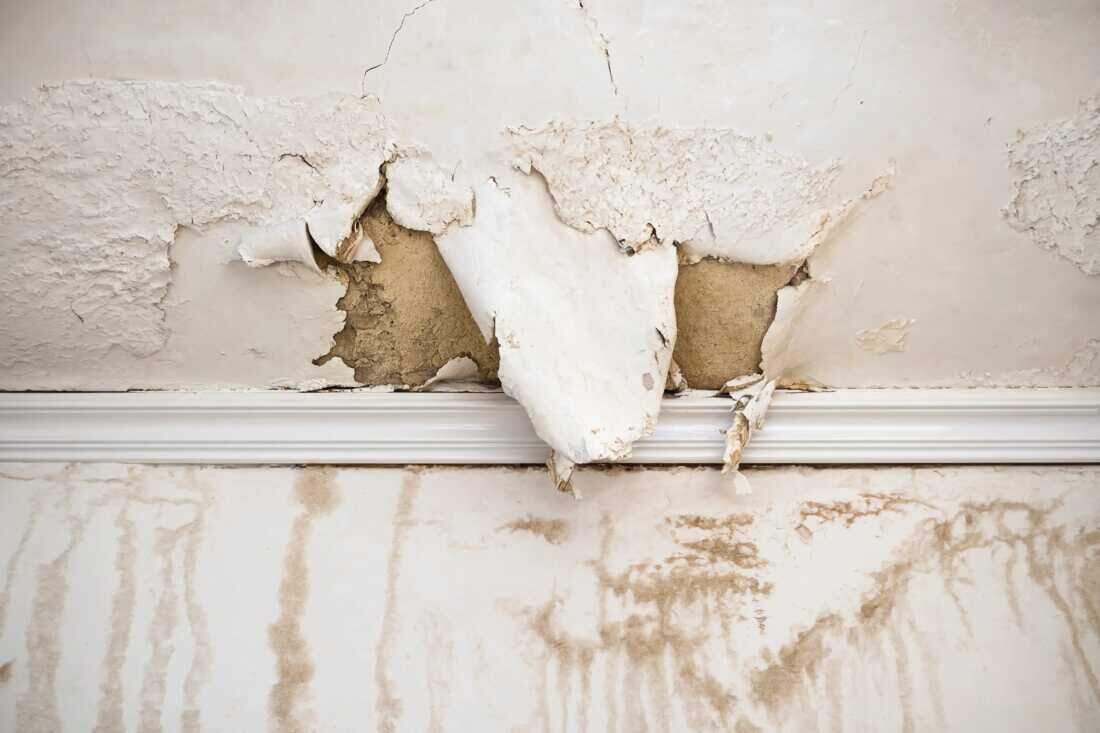
In Queens a roof leak is a two-story problem before it is a one-room stain. The neighborhood runs on pitched, asphalt-shingle one- and two-family homes, and most of those roofs are fifteen or twenty years past their last tear-off, so the flashing in the valleys and around the dormers is what fails first. Rain that gets past it does not drip straight down; it rides the rafters to the top-floor ceiling, then keeps tracking the wall framing toward the finished basement that so many Queens houses carry underneath. By the time the ceiling browns, the cavity above it has been wet for a while and the insulation is holding water.
That vertical path is exactly why roof water damage repair here can't stop at repainting the mark. We run a Queens roof leak as one continuous job out of our Brownsville base, usually 45 to 60 minutes out with traffic: tarp the breach so the next band of rain adds nothing, meter from the attic down through the wall to the basement framing, then run our own air movers and dehumidifiers on every wet layer until it reads dry, and rebuild. Bringing in one water damage roof repair company for the whole chain is what spares you the three-contractor runaround, the roofer, the dry-out crew, and the drywall guy each pointing at the next. Call (347) 906-9419 and a real person picks up, day or night.
What we cover in Queens
- Same-visit roof tarping — we seal the failed valley flashing, cracked shingle, or open dormer detail the same trip, so the roof stops feeding the ceiling while the drying runs and the permanent roof work gets scheduled.
- Attic-to-basement moisture mapping — we meter the attic, the ceiling cavity, the wall bays, and the basement framing so we chase the whole path the water took, not the one stain you can see.
- Metered drying & interior rebuild — air movers and dehumidifiers into every wet cavity, dried to a Tramex reading, then we cut out the ruined drywall and insulation and put the ceiling back once it reads dry.
- Documented loss for your carrier — the entry point, dated moisture readings per level, and the interior water path in a written file. We document the loss; your carrier decides what it covers.
Full detail on this service: Roof Water Damage in Brooklyn · or see every water damage service we provide in Queens.
Common questions in Queens
Water is showing up around the dormer on my Jamaica home — is that the roof or the flashing?
Almost always the flashing. Where a dormer sidewall meets the main slope is a step-flashing detail, and on a twenty-year-old shingle roof it's the first joint to open up, especially after a Queens winter of freeze-thaw working the metal loose. We tarp or seal the dormer to kill the active leak, then dry the ceiling cavity in the room below. We photograph exactly what we find, failed step-flashing, a lifted shingle, or both, so the cause is spelled out on the file your carrier reviews.
The same storm that leaked my roof also backed the sewer up into my South Ozone Park basement. Is that all one job?
One crew, but two separate losses, and in South Ozone Park they land together constantly: the storm drives the roof leak down while the combined sewer pushes contaminated water up through the floor drain. Clean rainwater off the roof and a sewer backup are handled differently, one dries, the other is a biohazard that gets extracted and sanitized, so we log and date each source on its own. That matters because your policy may treat the two under different coverage, and a merged report muddies both claims.
My Howard Beach roof is old and the leak came on slowly. Will homeowner's insurance still pay?
That usually turns on cause, and it's your carrier's call, not ours. A sudden failure, a wind-lifted shingle or flashing that let go in a storm, is generally treated as covered, while a roof that wore out and dripped over months is often denied as wear and tear. The useful part: the interior damage to your ceilings and walls is frequently covered even when the roof surface itself isn't. We record the entry point, the date of loss, and room-by-room moisture readings so your adjuster can separate the covered interior loss from the roof question. We don't promise an outcome we can't control.
The stain is on my top-floor ceiling but the leak is supposedly in the roof, feet away. How do you find where it actually gets in?
Roof water almost never drips straight down. It rides a rafter and runs a stud bay, then surfaces several feet from the breach, which is why a patch at the obvious spot often leaves the real entry wide open. On a Queens house we probe the flashing, valleys, and penetrations up top, then follow the water inside with moisture meters and a thermal camera until every wet cavity between the roof and the basement is mapped. We dry all of it, not just the ring you can see, so a fresh coat of paint doesn't ghost brown again a month later.
Licensed, insured & trained to industry standards


Roof leak running down through your Queens home? Call now.
A live person answers any hour, and a crew rolls from Brownsville, usually inside the hour with traffic. Every hour the roof stays open is more water in the ceiling cavity and more of it heading for the basement. We tarp the breach, dry the whole path to a meter, rebuild the ceiling, and document the loss for your carrier. Call (347) 906-9419.
Call (347) 906-9419