Brooklyn Water Damage Restoration: The 5-Step Process
The puddle on your kitchen floor is the small part of the problem. By the time you see it, the water has climbed the wall and slid under the cabinets. Here is what a restoration crew does about that, step by step, and how long each part takes.
The short version: the water damage restoration process is five steps. A certified crew finds and stops the leak, pumps out the water, pulls out whatever soaked past saving, then dries the framing and floors with air movers and dehumidifiers until the moisture readings hit target, cleans and disinfects the rest, and repairs what the water ruined. The sooner drying starts, the less has to be torn out, and the smaller the bill.
What is water damage restoration?
Water damage restoration returns a flooded or soaked building to a dry, safe, pre-loss condition. Mopping is not restoration. Restoration means measuring how far the water traveled, pulling it back out of materials that absorbed it, killing the bacteria a leak leaves behind, and rebuilding the parts the water destroyed.
The reason it is a trade and not a chore is the water you cannot see. Drywall wicks moisture upward like a paper towel. A puddle that looks contained on the floor has usually climbed a foot or two inside the wall cavity and slipped under the baseboard. Wet that sits gives mold a 24-to-48-hour head start. In Brooklyn that runs straight into the building stock: finished basements below the water table, century-old plaster that crumbles once it is saturated, and party walls shared with the brownstone next door, where one unit's leak becomes two units' problem. Getting the structure genuinely dry, fast, is what keeps a one-room riser leak from turning into a gut renovation.
The 5 steps, inspection to rebuild
The sequence is not a house style. It comes from the IICRC S500 standard, the reference every trained restoration company works to, and the order is deliberate: you cannot dry what you have not extracted, and you should not rebuild what has not metered dry. Here are the water damage restoration steps in order.
- Inspection and assessment. The crew finds the source and stops it first, then maps the damage with moisture meters and thermal cameras, including the water hiding inside walls and under floors. They classify the water type (clean, gray, or black) and the class of damage. That reading sets the whole plan.
- Water extraction. Standing water comes out with truck-mounted pumps and wet vacuums. Pulling the bulk of it in the first hours is what decides how far moisture spreads and how much material has to go. See water removal.
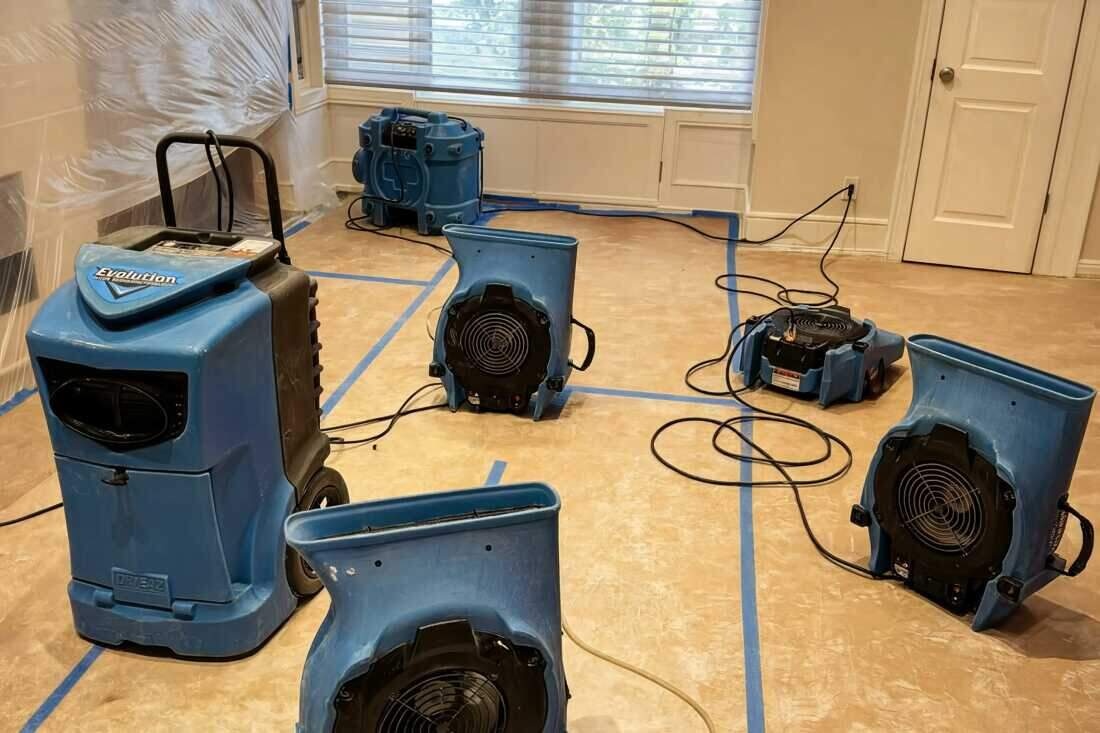
- Controlled removal, then drying. Anything too saturated to dry in place comes out first: swollen drywall, soaked insulation, delaminated flooring. That call is made off the meter, not by eye, so only what genuinely will not dry gets cut. Then air movers push wet air off the remaining surfaces while commercial dehumidifiers pull the moisture out of the room. Crews take moisture readings every day, usually for 3 to 5 days, until the framing and flooring read dry on a meter, not just dry to the hand. See structural drying.
- Cleaning and sanitizing. Affected surfaces and any salvageable contents get cleaned, disinfected, and deodorized. Gray and black water leave bacteria behind, so antimicrobial treatment happens here, along with the steps that stop mold before it starts. If mold has already taken hold, it moves to mold removal.
- Restoration and repairs. The last step rebuilds what was lost. New drywall and insulation, refinished or replaced flooring, fresh paint, fixtures reset, so the room reads like the loss never happened.
How long does water damage restoration take?
For most Brooklyn jobs the drying phase runs 3 to 5 days. The full timeline, drying plus any rebuild, depends on three things: how much water there was, how dirty it was, and what soaked it up. Porous materials hold water far longer than hard ones. Carpet, drywall, and hardwood can stay wet for days after tile and concrete have given up their moisture.
| Severity | Drying time | Total with repairs |
|---|---|---|
| Minor — small spill, one room caught fast | 1 – 2 days | 2 – 4 days |
| Moderate — multi-room, soaked drywall & flooring | 3 – 5 days | 1 – 2 weeks |
| Major — flooded basement, sewage, or mold | 5 – 7+ days | 2 weeks – several months |
Drying is finished when the moisture readings hit target, not when the calendar says so. Closing the walls back up before the structure is truly dry is the most common reason mold turns up months later, behind paint that looked fine.
Nobody sets the dry time up front. The crew sets a target reading for each material, then meters the framing and floors once a day and adjusts the equipment until those numbers come down. Three things decide how many days that takes: what soaked (a plaster wall holds water far longer than modern drywall), how dirty the water was (contaminated jobs pull more material out, which changes what is left to dry), and how deep it saturated. Prewar plaster and lath, the norm in older Brooklyn walk-ups, is the slow case: it can add a day or two over a comparable drywall room, and rushing it is how the moisture ends up sealed inside. The daily numbers, not a guess on day one, are what say when the meters come off.
Water categories and classes, and why they matter
Two ratings drive every plan and every estimate. The category describes how contaminated the water is. The class describes how much of it there is and how stubborn it will be to dry. Together they decide what can be saved and what has to be cut out.
| Category | Where it comes from | What it means for the job |
|---|---|---|
| Category 1 — clean | Burst supply line, sink overflow, rainwater | Sanitary. The fastest and cheapest to dry, if you catch it early |
| Category 2 — gray | Dishwasher, washing machine, sump overflow | Some contamination. Needs cleaning and sanitizing, not just drying |
| Category 3 — black | Sewage backup, storm flooding, toilet overflow | Grossly contaminated. Needs containment, and soaked porous material gets removed, not dried. See sewage cleanup |
Category climbs with time. A clean Category 1 leak that sits for two days, breeding bacteria in the wet drywall, is treated as Category 2. That escalation is another reason the first day matters.
The four classes rate the drying difficulty:
- Class 1: the least water, a small area of low-porosity materials. Dries quickly.
- Class 2: a whole room with carpet, water wicking up the walls a foot or two.
- Class 3: water from above. Ceilings, walls, and insulation are all saturated.
- Class 4: deep-bound water in plaster, hardwood, or concrete. Needs specialty drying, common in older Brooklyn buildings.
Mitigation, remediation, and restoration are three different jobs
People use these three words interchangeably, but on an estimate they mean different work at different stages. Knowing which is which helps when you read a scope or talk to your insurer.
| Term | What it covers | When it happens |
|---|---|---|
| Mitigation | Stopping the damage from getting worse: extraction and drying | First, the emergency phase |
| Remediation | Cleaning, sanitizing, and removing contamination or mold | Middle phase, after drying |
| Restoration | Rebuilding and repairing back to pre-loss condition | Final phase |
"Water damage restoration" is the umbrella term that covers all three. A full job runs mitigation first to stop the bleeding, remediation to make the space safe, then restoration to make it whole. On an insurance claim the line usually falls here: mitigation and remediation get billed as one stage, the rebuild as another.
The claim file builds itself as the work happens
Your insurer decides what is covered; the crew's job is to hand the adjuster a file they cannot argue with. That file starts at the first inspection and grows with every step. The source gets photographed before anything is touched. The moisture map from day one becomes the baseline. Every daily reading, every cut line, every piece of removed drywall is logged and dated, so the scope you are billed for matches what the meters actually showed.
That is the honest split, and it is worth stating plainly. Reliable Brooklyn Water Damage Restoration documents the loss from the first walkthrough and bills your carrier directly, so you are not fronting the cost. What we cannot do is promise an outcome from your policy. A burst supply line is usually covered; gradual seepage you left for months often is not. Your adjuster makes that call. What moves a claim is a clean, dated, defensible record, and that is the one thing the process produces from the moment the first photo is taken.
What is the first step in water damage restoration?
Inspection and source control. Before any water comes out, the crew finds and stops the source, then maps the full extent with moisture meters and thermal cameras, including the water hidden in walls and under floors. That assessment sets the category, the class, and the entire drying plan.
What does a restoration company actually do?
A restoration company dries the structure and rebuilds it, which is the work a plumber or a cleaning service does not cover. We meter the moisture, extract the water, pull out what soaked past saving, run drying equipment to a target reading, sanitize, and repair the drywall, flooring, and paint. We also document the whole loss for your insurer. Fixing the pipe itself is the plumber's job; everything the water touched is ours.
How fast can you get to my place in Brooklyn?
We run 24/7 and a real person answers, not an answering service. From our Brownsville base we usually reach most of Brooklyn in around 45 minutes, depending on traffic and where you are. We cover the four other boroughs too, which can take a little longer. Call (347) 906-9419 any hour and we will tell you our honest ETA.
Can I do water damage restoration myself?
A small, clean spill caught immediately, yes. But anything that has soaked into drywall, flooring, or a wall cavity needs commercial extraction and drying. A household fan will not dry the inside of a wall, and water that looks gone usually is not. For gray or black water, doing it yourself is unsafe. When in doubt, call us and we will tell you straight whether you need a crew.
Dealing with water damage in Brooklyn right now?
The clock starts the moment water hits. Call Reliable Brooklyn Water Damage Restoration and a real person picks up 24/7. We will inspect, hand you a written scope, get drying equipment running, and document the loss for your insurer.
Call (347) 906-9419