Water Mitigation in East New York, NY
A washing-machine hose lets go in the top-floor unit of a Cypress Hills two-family, and the water soaks the ceiling of the rental below before the tenant downstairs hears the drip. We meter both floors, dry the framing, and paper each unit for its claim.
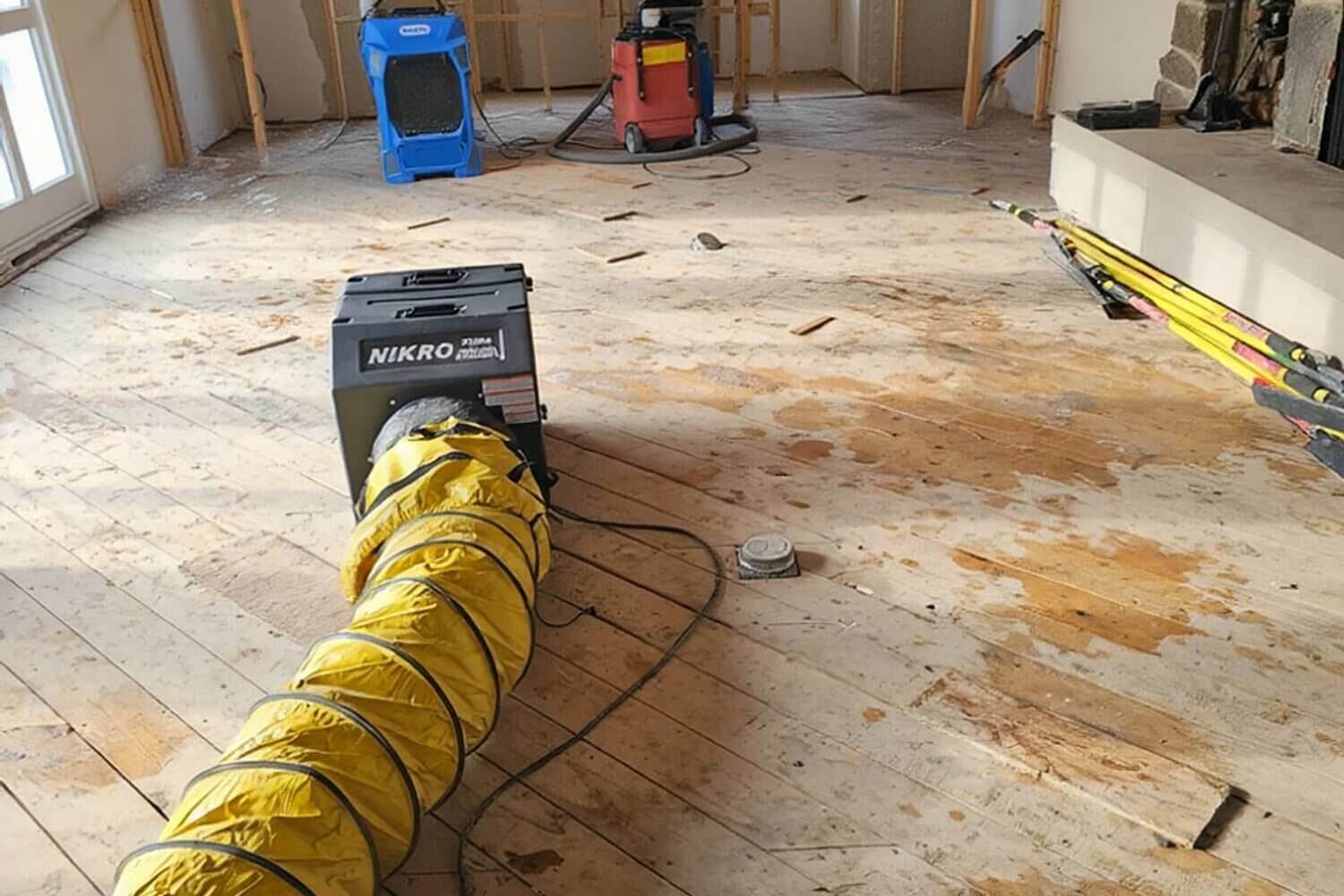
Water mitigation is the emergency work that decides how big a repair gets, and in East New York it usually plays out inside a two-family house. The brick and wood-frame homes across Cypress Hills and along New Lots and Pennsylvania Avenues stack an owner's unit over a rental, so a failure on one floor, whether a burst washer hose, a split supply line in a framed wall, or an overflowing tub, drops straight through the joists into the apartment below. That vertical path means two units are wet at once and often two separate claims. We stop the source, pull the standing water, and dry both floors to a verified reading before the framing warps.
As a water mitigation company we run one fixed sequence. First we shut the source and extract the standing water with submersible pumps and an extractor. Then we strip only the porous materials that cannot be saved, set air movers and dehumidifiers, and dry to a moisture target we confirm with a meter instead of a glance. Every step gets photographed and logged for each affected unit, since the owner upstairs and the tenant below each file their own claim. We dispatch from our Brownsville base and usually reach an East New York address in about 45 minutes, though storms and traffic move that number. A real person answers at (347) 906-9419, day or night. We document the loss; your carrier decides what it covers.
What we cover in East New York
- Source off, water out — we close the failed hose or valve and extract the standing water with submersible pumps and an extractor before it wicks up the walls below.
- Both floors, one job — a leak that dropped through the joists soaks the upstairs floor and the downstairs ceiling, so we dry them together and document each unit on its own.
- Tear out only the losses — soaked drywall, wet insulation, and delaminated subfloor come out to a clean edge; sound framing and sealed surfaces stay and dry in place.
- Metered dry-down — daily moisture readings on the ceiling cavity, walls, and subfloor to a verified target, so nothing damp gets sealed behind a new wall.
Full detail on this service: Water Mitigation in Brooklyn · or see every water damage service we provide in East New York.
Common questions in East New York
The leak started in my upstairs unit and soaked my tenant's ceiling below. Whose insurance handles what?
Usually it splits by what each policy covers. Your homeowner's or dwelling policy covers the building — the structure of both the upstairs unit and the downstairs ceiling and walls. Your tenant's renter's policy, if they carry one, covers their damaged belongings. If the failure was sudden and accidental, like a burst washer hose, it is typically a covered loss on the dwelling side. We document each unit separately with its own photos, readings, and materials list so the building claim and any contents claim stay clean and do not get tangled. We document the loss; your carrier decides what it covers.
My tenant is still living in the downstairs unit. Can you dry it without moving them out?
Usually, yes. Most single-source clean-water losses are dried with the residents in place — we contain the wet rooms, run air movers and dehumidifiers in those areas, and keep the rest of the unit livable. Where it gets disruptive is a soaked ceiling that has to be partly opened to dry the joist cavity, or a large tear-out; in those cases we scope it with you first and stage the work to keep as much of the apartment usable as possible. The gear does run continuously for several days, which is loud, so we set expectations with the tenant up front.
How much of the downstairs ceiling and the upstairs floor can be saved?
With clean water caught early, more than people expect. Drywall or plaster that stayed saturated and sagging comes down, and wet insulation in the ceiling cavity comes out, since both hold water against the framing. But sound framing, subfloor that has not delaminated, and hardwood that has not badly cupped can usually be dried in place. We make each keep-or-remove call with a meter on the material itself, not by its appearance on day one, and we log what gets discarded so your insurer sees exactly what came out and why.
How fast can you get to East New York, and what should I do while I wait?
From our Brownsville base an East New York arrival usually runs about 45 minutes, though a storm or heavy traffic will move that. While you wait, shut the water at the valve behind the appliance or at the main, and stop the source. If the panel is dry and reachable, kill power to the wet rooms, since water and outlets are a bad mix. Move what you can lift off the floor and shoot a few photos of the water line. Then call (347) 906-9419 and a real person picks up.
Licensed, insured & trained to industry standards


Water through the ceiling in an East New York two-family? Call now.
A Brownsville crew answers live, 24/7, and rolls with its own pumps and meters. We stop the source, extract, dry both floors to a metered target, and document each unit for its own claim. Call (347) 906-9419.
Call (347) 906-9419