Water Mitigation in Queens, NY
A water-heater tank rusts through in the attached garage of a Bayside colonial, and the tank empties across the utility room and down into the finished space below. Caught the same morning, that stays a dry-out, not a rebuild. We answer any hour and roll from Brownsville.
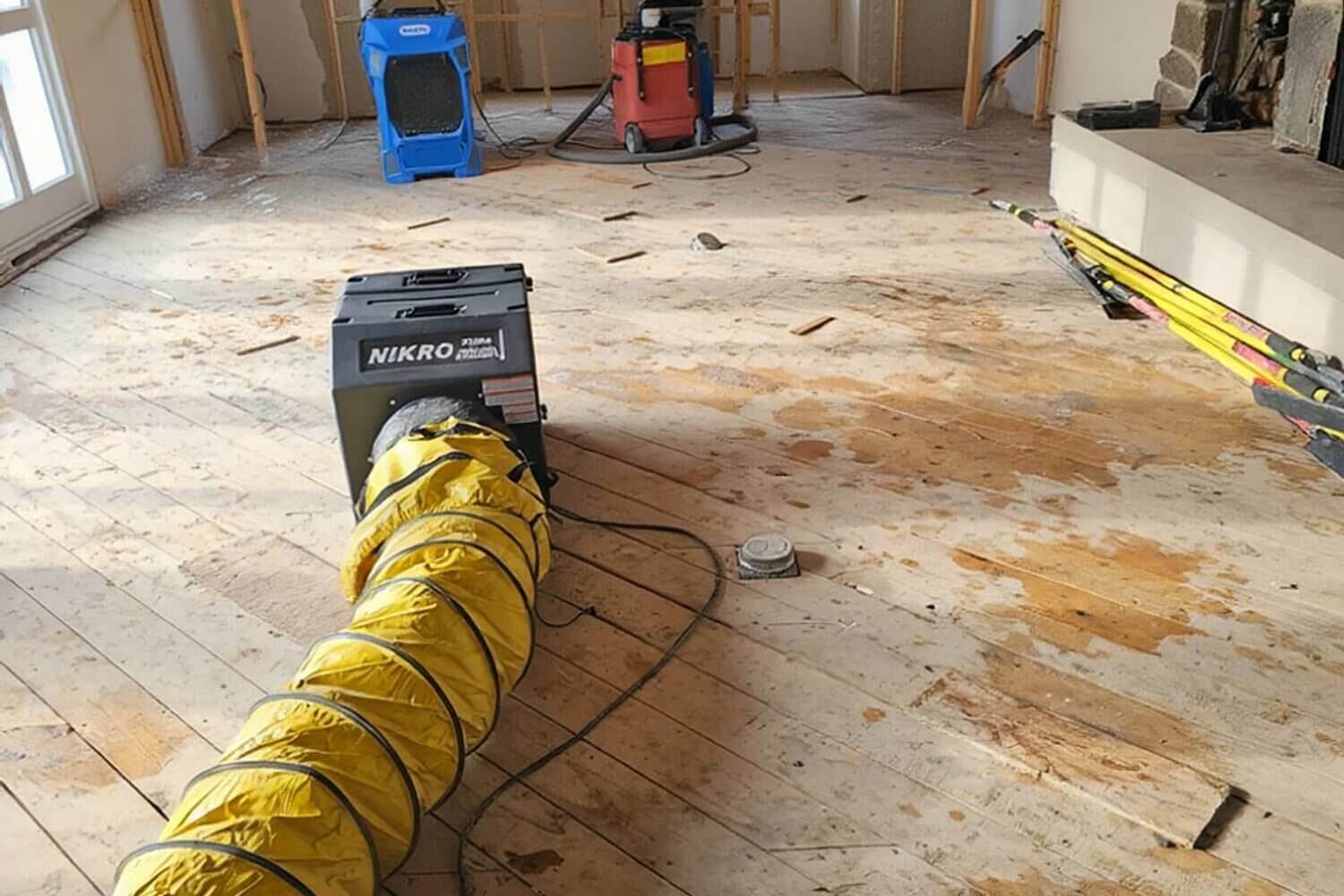
Water mitigation is the emergency phase of a water loss, and in Queens it is mostly a below-grade story. The one- and two-family homes across Bayside, Fresh Meadows, Jamaica Estates, and Howard Beach put the laundry, the water heater, and the boiler in a basement or an attached garage, and that is the low point everything drains toward. A tank that lets go, a washer hose that splits, a first-floor supply line that fails all send water down through the subfloor into the space below, where it pools against the framing and sits. We pull that water out and dry the structure before it warps and before mold gets a start.
As a water mitigation company we work one fixed order, and it does not change with the address. We stop the source, extract the standing water, and check the category, which matters the moment a combined-sewer backup is involved instead of a clean supply-line break. We strip only the porous materials that cannot be safely dried, set air movers and dehumidifiers, and run them to a metered target rather than a look. Every reading and every photo goes in the file your adjuster works from. We dispatch from our Brownsville base and usually reach a Queens address in 45 to 60 minutes, traffic depending, and a real person answers the phone any hour. We document the loss; your carrier decides what it covers.
What we cover in Queens
- Source off, water out — we close the failed valve, tank supply, or appliance line and clear the standing water with truck-mounted and submersible pumps before it wicks up the finished walls below.
- Contain it to one level — a garage or first-floor failure wants to keep draining, so we seal off the wet level and dry it as one zone instead of letting it migrate room to room.
- Take out only what is lost — soaked drywall, wet insulation, and delaminated flooring come out to a clean edge; sealed concrete, tile, and sound framing stay and dry in place.
- Dry to a reading — we meter the walls and slab every day and pull the equipment only when the numbers hit dry standard, so nothing damp gets sealed back into the space.
Full detail on this service: Water Mitigation in Brooklyn · or see every water damage service we provide in Queens.
Common questions in Queens
My water heater ruptured in the attached garage and flooded down into the finished room. Is that one claim or two?
Usually one claim covering both areas, since it is a single sudden-and-accidental event. Homeowner policies generally treat a failed water-heater tank as covered water damage, and the payout follows the water: the garage the tank sat in and the finished space it drained into are both part of the loss. What the policy typically will not pay for is the heater itself, only the damage it caused. We document the tank, the flow path, and every wet material as one connected event so your adjuster sees the full picture. We document the loss; your carrier decides what it covers.
The water in my Fresh Meadows basement drained off on its own. Do I still need mitigation?
More often than not, yes. Water that leaves the surface has not left the building — it sits in the subfloor, the bottom plates of the finished walls, and the insulation, and below grade it can stay there for weeks with nowhere to evaporate to. We meter those materials instead of guessing. If the readings come back at dry standard, we tell you and leave your walls alone. If they do not, we dry the cavities now, while this is still a drying job and not a mold job. In a below-grade Queens space, what looks dry on the surface is routinely still wet a foot down.
How long does drying out a finished Queens basement take?
Extraction happens the first visit, usually within a few hours of arriving. Drying is the longer stretch. For a clean supply-line or tank failure, air movers and dehumidifiers typically run three to five days, longer when the water sat overnight or the finished walls are insulated, because insulation holds moisture against the framing. We log a fresh moisture reading every day and pull the gear only when the walls and slab confirm dry, never on a fixed schedule. You get an update each day, so there is no wondering where it stands.
Can I really reach a real person at 3 a.m. in Queens, not an answering service?
Yes. A technician answers the phone live, day or night, not a service taking a message for the morning. Overnight is exactly when a basement loss does its quiet damage: by sunrise the subfloor has drunk up whatever was standing, and the mold clock is already running. While you wait for the crew, find the main shutoff and stop the water, and lift what you can off the floor. Then call (347) 906-9419 and we roll from Brownsville.
Licensed, insured & trained to industry standards


Water in a Queens basement or garage? Call now.
A Brooklyn crew is on the road to Queens, any hour, with its own pumps and meters. Every hour the water sits below grade, it climbs another wall and soaks more framing, so the call you make now is the one that saves the most. We stop the source, pump it out, dry the structure to a meter reading, and document the loss for your carrier. Call (347) 906-9419.
Call (347) 906-9419