Water Removal in Bushwick, NY
A steam-heat riser lets go inside a partition wall of a Johnson Avenue loft in a January cold snap, and hot water runs the length of the poured floor before you wake to it. We answer live, pull the water off the slab, and start the dryers.
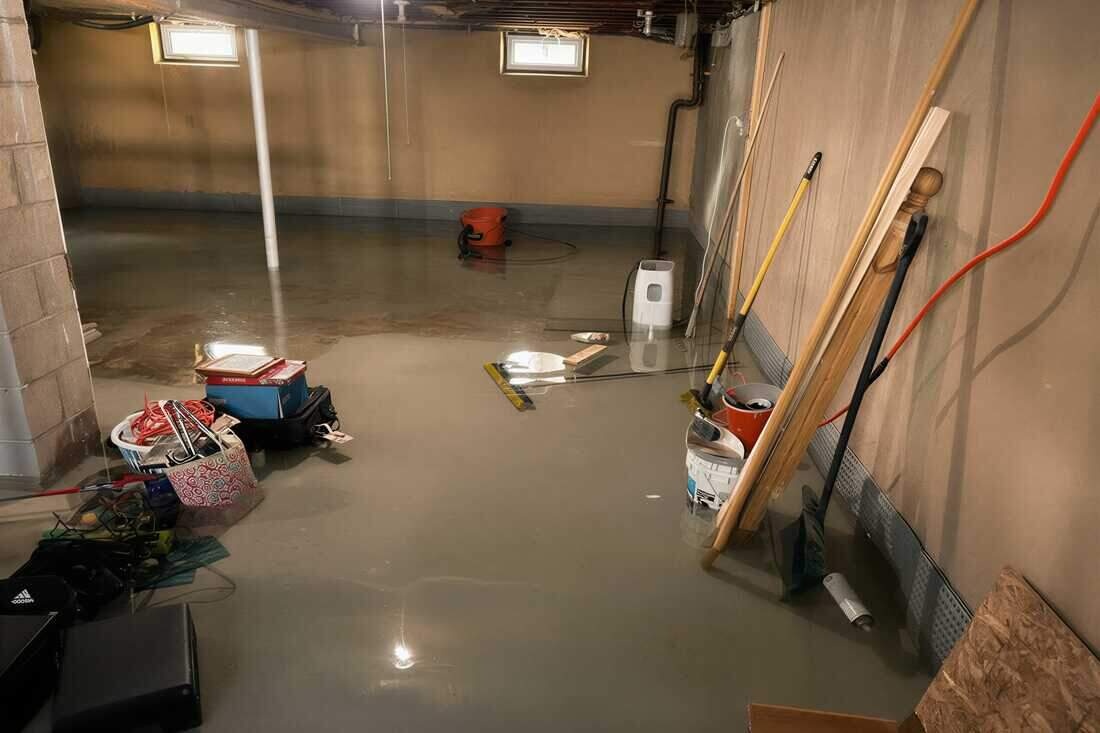
Water removal in Bushwick has to reckon with where the water goes, not just where it started, because the loft floors here send it sideways. The gut-converted warehouses along Johnson and Ingraham lay engineered plank or a thin overlay flat across a poured concrete slab, so a burst supply fitting or a failed heating line spreads a sheet of water across the whole plan and slides under the finish long before it pools anywhere you can see. Our job is to chase the full wet edge, and a real water removal company shows up reading it with a meter and a thermal camera rather than mopping the part that shows.
Reliable Brooklyn Water Damage Restoration runs the extraction in a set order. Truck-mounted vacuums lift the standing water off the slab and the plank first, then we pull sections of flooring to reach what slid underneath, and a moisture map marks every damp pocket in the partitions before air movers and dehumidifiers go in and stay until the concrete and framing read dry on the instrument. These emergency water removal services run around the clock, answered by a live person and not a service, which counts most at 3 a.m. when a loft leak has been running for hours. From a Brownsville base a crew usually reaches Bushwick in roughly 45 minutes, traffic depending. We log the source, the depth, and every reading; we document the loss, and your carrier decides what it covers.
What we cover in Bushwick
- Truck-mounted extraction — high-vacuum units sweep the standing water off an open loft slab and the plank floor over it in passes, before it slides any further under the finish.
- Flooring lifted to the slab — we pull engineered plank and overlay sections to extract the water that traveled beneath them, instead of pressing it down into the concrete and the seams.
- Thermal + meter mapping — a thermal camera and a moisture meter trace where the sheet of water ran across the slab and into the partition walls, so the whole wet footprint gets dried, not just the visible edge.
- Dried to a reading — air movers and dehumidifiers stay on the slab and the framing until a daily meter log confirms dry, with anything at mold risk watched the whole way through.
Full detail on this service: Water Removal in Brooklyn · or see every water damage service we provide in Bushwick.
Common questions in Bushwick
The water came off a steam-heat line, not a burst supply pipe. Does that change how you pull it out?
The extraction itself is the same, but a heating line changes what we watch. Water off a steam or hydronic system starts clean, so caught the same day it can usually be extracted and the structure dried in place. What it does is run hot and find every seam, so on an engineered-plank floor it swells the boards and lifts the glue faster than cold water would, and it can carry rust and sediment out of an old iron system that stains what it touches. We meter the plank and the slab, dry what can be saved, and flag the boards that have already delaminated so the call on replacement is made on a reading, not a guess. Call (347) 906-9419 and a crew heads out.
My loft floor looks fine three feet from the leak, but is the slab under it actually wet that far out?
Almost certainly farther than the plank shows. On a flat poured slab water follows the path of least resistance under the finish, so it spreads well past the darkened boards and often reaches the base of a partition wall you'd never suspect. We run a thermal camera to see the cold wet zone, confirm the edges with a moisture meter, and lift plank where the readings say the water traveled. Drying only the visible patch leaves the slab wet under a floor that looks dry, and that is exactly where mold restarts weeks later. We map the real footprint before any gear goes down.
I'm in one of the newer condo conversions off Flushing Avenue. Who handles the loss when the building has an HOA?
It usually splits, and the paperwork is part of what we run so it isn't on you. In a condo the association's master policy generally answers for the building systems and common structure, while your own unit-owner policy covers your finishes and belongings; where the failed line sits in the offering plan decides the rest. We coordinate access with the managing agent, document the source and the path the water took, and log every soaked material under your unit so both carriers work from the same record. Give us the managing agent's name on the call and we start that file on arrival.
How fast can a crew reach my loft near the Morgan or Jefferson L, and what should I do first?
We answer 24/7 with a live voice, no answering service, and from a Brownsville base usually reach Bushwick in roughly 45 minutes, depending on the hour and where you sit off the L. We give a straight window on the call rather than a number we can't hold. While you wait, if it's a heating line, the shut-off is usually a valve at the boiler or the base of the riser, so kill that if you can reach it safely; if it's an appliance, close its supply valve. Keep everyone off the wet floor so the water doesn't track further across the slab, and lift what you can carry.
Licensed, insured & trained to industry standards


Water spreading across a Bushwick loft floor? Call now.
A Reliable Brooklyn Water Damage Restoration crew rolls to Bushwick any hour, with a live person on the line when you call. Every hour the water sits, it slides farther under the plank and into the partitions, so the sooner we're on it, the less comes out. We pump it out, dry the slab and framing to a meter reading, and document every step for your claim. Call (347) 906-9419.
Call (347) 906-9419