Water Removal in Queens, NY
A washing-machine hose lets go on the parlor floor of a Woodside two-family, and the water drains down into the rented garden apartment below. We roll a truck, pull the standing water off both levels, and get the framing drying before it climbs the studs.
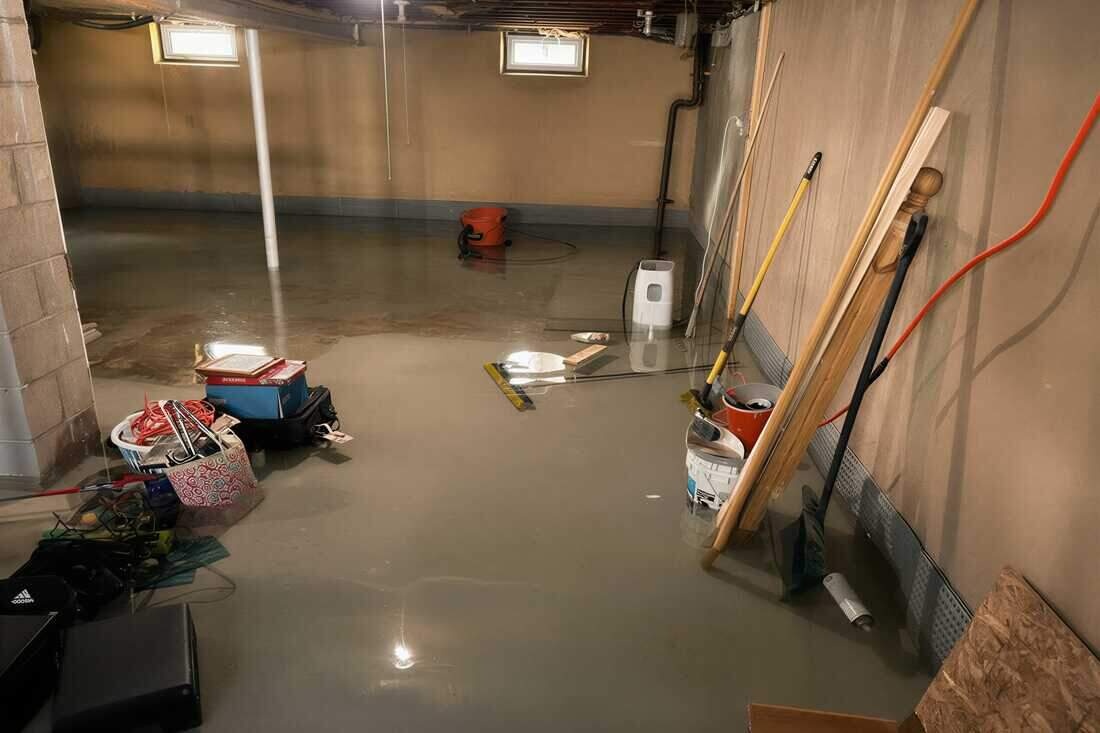
Water removal in Queens is mostly a basement job, because more houses here finish the lower level into a den, a home office, or a rental than in any other borough, and that is the floor the water reaches first. A washing-machine hose or a water-heater connection lets go in an attached brick two-family in Woodside or Astoria, the clean supply water rides the platform framing down through the joists, and the garden unit below is standing in it by morning. Pulling that standing water fast is the one step you cannot leave until tomorrow, because every hour it sits it climbs higher into the drywall and deeper into the subfloor.
Our water removal services run in two motions at once. Truck-mounted vacuums lift the water off the finished floors and along the wall bases while a submersible pump drains any cellar that pooled below the reach of a hose, and then a Tramex meter maps where the moisture tracked into the wall cavities so the wet you cannot see gets dried instead of sealed behind fresh paint. A Reliable Brooklyn Water Damage Restoration crew reaches most of the borough in roughly 45 to 60 minutes from a Brownsville base, traffic depending, and a real person answers the phone at any hour rather than an answering service taking a message. In an attached row the party wall matters, so we meter into the neighbor's shared framing too, since clean water crosses through it before either owner sees a stain. We log the source, the depth, and every reading; we document the loss, and your carrier decides what it covers.
What we cover in Queens
- Truck-mounted extraction — high-volume vacuums pull standing water off finished basement floors, stair runs, and wall bases in passes, not a bucket at a time.
- Submersible pump-out — for the deep water that pools below-grade in an attached-house cellar, well past where a vacuum hose can reach.
- Party-wall metering — we read into the shared framing an attached Queens row runs on, so water that crossed to the neighbor gets found before it stains their side.
- Same-visit drying start — air movers and dehumidifiers go in the same trip, so the subfloor and studs begin drying now instead of the next day.
Full detail on this service: Water Removal in Brooklyn · or see every water damage service we provide in Queens.
Common questions in Queens
The water came from a washing-machine hose, not a burst pipe. Does that change how you pull it out?
The extraction is the same, but the water class steers what has to come out. A clean supply hose off a washer or a dishwasher starts as Category 1 water, so caught the same day it can usually be extracted and the structure dried in place with little demolition. Left to sit a day or two it degrades toward gray water as it picks up soil from the flooring and the pad, and porous materials that soaked it up may then need replacing. We test and log the category the minute we walk in, so the call on what stays and what goes is made on evidence, not a guess. Call (347) 906-9419 and a crew heads out.
My house is attached to my neighbor's. If the water crossed the party wall, whose problem is that?
It becomes both houses' problem, and we handle it that way. An attached Queens row shares its stud framing, so clean water from your side keeps soaking into your neighbor's plaster no matter who caused the leak. We meter the wall from your side, map how far it traveled, and dry your structure, logging every reading and photo under your address so your file stands on its own. When the neighbor gives access, drying the shared cavity from both faces goes faster and tears out less. Who pays in the end is for the two insurers to settle; our part is a clean record of your half.
How long before my finished Queens basement is dry once the water's pumped out?
The pump-out and extraction usually wrap in a couple of hours. The drying that follows runs three to five days for most finished basements, longer if the water sat before we got there or the slab took on a lot. We set air movers and dehumidifiers on day one and meter the materials daily, pulling each piece of gear as that surface hits a dry standard rather than running a fixed timer. You get a straight timeline after the first reading, never a flat promise, and we tell you which materials can dry in place and which are past saving before anything gets torn out.
How fast can you reach my Queens house, and is it different if I'm out toward Bayside?
It is, and we will be honest about it. We run around the clock from a Brownsville base, and southern Queens off the Belt Parkway, Howard Beach, South Ozone Park, and Jamaica, is usually inside an hour depending on traffic. Bayside, Flushing, and the northeast corner are the longest runs we make in the borough, and rush hour can push them well past that, so we quote a real window on the phone rather than a number we cannot keep. While you wait, shut the water at the main if you can reach it safely, and keep people off the wet flooring so it does not track further.
Licensed, insured & trained to industry standards


Standing water in your Queens basement? Call now.
A Reliable Brooklyn Water Damage Restoration crew is on the road to Queens any hour, with a live person on the line when you call. We pump the basement out, extract and dry the structure to a meter reading, meter the party wall where the water crossed, and document every step for your claim. Call (347) 906-9419.
Call (347) 906-9419